3-Month Plan to Ace Standardized Tests for 2026 Admissions
Advertisements
A strategic 3-month plan to ace your standardized tests for 2026 admissions involves diligent preparation, consistent practice, and effective time management to maximize scores and enhance college applications.
Preparing for college admissions can feel like a marathon, and standardized tests often represent one of the most significant hurdles. If you’re aiming for 2026 admissions, a well-structured approach is crucial. This article outlines a comprehensive 3-month plan to ace your standardized tests, providing actionable strategies and insights to help you achieve your target scores and confidently apply to your dream schools.
Understanding the Landscape: SAT vs. ACT and Test Dates
Before diving into intense preparation, it’s essential to understand the fundamental differences between the SAT and ACT and to identify the optimal test dates for your 2026 admissions cycle. Many students choose to take both tests or focus on the one that best suits their strengths. Making an informed decision early on can significantly streamline your study efforts.
The SAT, known for its emphasis on reasoning and problem-solving, consists of Evidence-Based Reading and Writing, and Math sections. The ACT, conversely, tests more directly on curriculum-based knowledge across English, Math, Reading, and Science. Each test has its unique scoring system and question types, making it vital to familiarize yourself with both.
Choosing Your Test: SAT or ACT?
Deciding which test to prioritize often begins with diagnostic tests. Taking a full-length practice SAT and ACT under timed conditions can provide invaluable insight into which format you find more comfortable and where your natural strengths lie. This initial assessment helps you allocate your study time more effectively.
- Diagnostic Testing: Spend a weekend taking one full practice SAT and one full practice ACT.
- Analyze Scores: Compare your scores, paying attention to section-specific performance.
- Consider Content: Reflect on which test’s content and question styles felt more intuitive.
- Research Colleges: Verify which tests your target colleges accept, though most accept both.
Ultimately, the choice is personal, but remember that many students perform equally well on both with adequate preparation. The goal is to maximize your score on the test that aligns best with your learning style and academic background.
Once you’ve chosen your primary test, or decided to tackle both, marking down crucial test dates is the next step. For 2026 admissions, tests typically occur in the spring and fall of your junior year, and the fall of your senior year. Early planning allows for retakes if necessary, reducing last-minute stress.
Month 1: Foundation Building and Diagnostic Assessment
The first month of your 3-month plan to ace your standardized tests is all about establishing a strong foundation. This involves understanding the test structure, identifying your weaknesses, and beginning targeted content review. Rushing into practice tests without a solid grasp of the underlying concepts can be counterproductive.
Begin by gathering all necessary study materials. This might include official test prep guides, reputable online platforms, and flashcards. Organize your study space to minimize distractions and create an environment conducive to focused learning. Consistency, even in small increments, will be your greatest asset during this phase.
Initial Diagnostic and Goal Setting
Your first week should involve taking a full-length, timed diagnostic test for your chosen exam (SAT or ACT). This isn’t about achieving a perfect score but rather about establishing a baseline and pinpointing areas that require the most attention. Be honest with yourself about your performance.
- Take a Full Practice Test: Simulate actual test conditions as closely as possible.
- Thoroughly Review Answers: Understand why you got questions wrong, not just that they were incorrect.
- Identify Weaknesses: Categorize your errors by subject, topic, and question type.
- Set Realistic Goals: Based on your baseline, set an achievable target score.
After your diagnostic, create a detailed study schedule. Allocate specific times each day or week for studying, incorporating both content review and practice. Ensure your schedule is realistic and allows for breaks to prevent burnout. This structured approach will keep you accountable and on track throughout the three months.
Focus on reviewing the core academic concepts tested. For the SAT, this means brushing up on algebra, geometry, and advanced math concepts, alongside critical reading and grammar rules. For the ACT, it includes similar math topics, English grammar, reading comprehension, and basic science interpretation. Utilize online resources like Khan Academy or official test prep books for comprehensive content review. This foundational month sets the stage for more intensive practice later on.
Month 2: Targeted Practice and Strategy Development
With a solid foundation from Month 1, the second month of your 3-month plan to ace your standardized tests shifts focus to targeted practice and developing effective test-taking strategies. This is where you begin to apply your knowledge under timed conditions and learn to navigate the specific challenges of each test section. Consistent practice is paramount here.
This month should be characterized by a significant increase in practice questions and section-specific drills. Don’t just do practice problems; analyze them. Understanding the logic behind correct answers and identifying common traps for incorrect ones is a skill that improves with deliberate practice. Focus on quality over sheer quantity of problems.
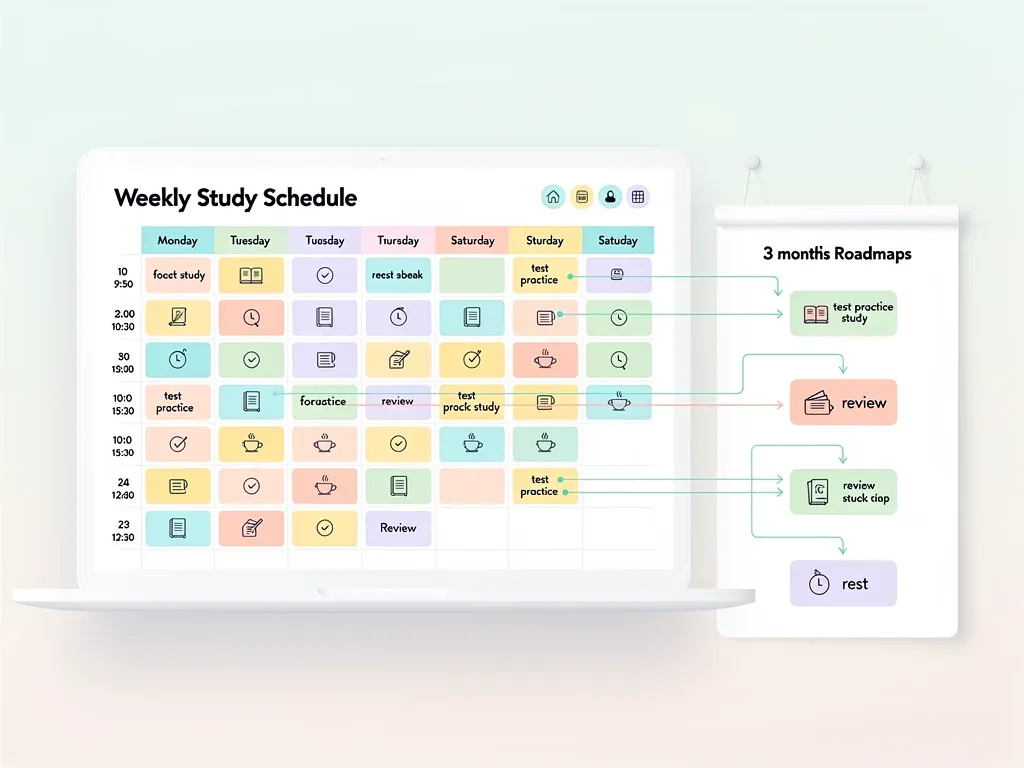
Drilling Down on Weaknesses
Based on your Month 1 diagnostic, dedicate significant time to your weakest areas. If math is a struggle, spend extra time on those specific concepts. If reading comprehension is challenging, practice active reading techniques and question analysis. Use official practice tests and reputable study guides for these drills.
- Section-Specific Practice: Dedicate blocks of time to individual sections where you struggle most.
- Timed Drills: Practice answering questions within the allotted time limits for each section.
- Error Log: Keep a detailed log of every question you get wrong, noting the type of error and the correct approach.
- Strategy Refinement: Experiment with different strategies for pacing, skipping questions, and process of elimination.
Beyond content, this month is crucial for developing test-taking strategies. Learn how to manage your time effectively in each section, when to guess (or not to guess), and how to approach different question formats. For example, on the SAT Reading section, practicing how to quickly locate evidence in the text can save valuable minutes. For the ACT Science section, understanding how to interpret graphs and data efficiently is key.

Incorporate full-length practice tests every two weeks during this month. These simulations are vital for building endurance and familiarity with the test environment. After each practice test, conduct a thorough review, focusing on applying the strategies you’ve learned and reinforcing your understanding of the content. This iterative process of practice, review, and refinement will propel your scores upward.
Month 3: Refinement, Full-Length Tests, and Mental Preparation
The final month of your 3-month plan to ace your standardized tests is dedicated to refining your skills, taking multiple full-length practice tests, and crucially, focusing on mental preparation. At this stage, you’ve built a strong knowledge base and developed strategies; now it’s about perfecting your execution and building confidence for test day.
Avoid introducing new, complex material in this final month. Instead, concentrate on solidifying what you already know and making your test-taking process as efficient and automatic as possible. This period is about fine-tuning, not overhauling, your approach. Trust the preparation you’ve already put in.
Simulating Test Day Conditions
Take at least two to three full-length practice tests under strict, timed conditions, ideally on the same day and time as your actual test. This helps your body and mind adapt to the demands of a long examination. Use official College Board or ACT practice tests for the most accurate simulation.
- Strict Timing: Adhere precisely to section time limits, including breaks.
- Test Environment: Replicate the actual test setting as much as possible (quiet room, no distractions).
- Post-Test Analysis: Review every question, especially those you answered correctly but struggled with.
- Pacing Adjustment: Make final adjustments to your pacing strategy based on these simulations.
Beyond academics, mental preparation is critical. Practice mindfulness or relaxation techniques to manage test anxiety. Ensure you’re getting adequate sleep, eating nutritious meals, and incorporating light exercise into your routine. A calm and focused mind can significantly impact performance.
The week leading up to the test should be about light review and rest. Avoid cramming new information. Instead, glance over your error log, review key formulas, and visualize yourself succeeding. Get a good night’s sleep before the test, and eat a balanced breakfast. Trust in your preparation; you’ve worked hard to get to this point, and you are ready.
Mastering Each Section: Key Strategies for Success
To truly ace your standardized tests, a general study plan isn’t enough; you need specific strategies for each section. Whether it’s the SAT’s evidence-based reading or the ACT’s science reasoning, each component demands a tailored approach. Understanding these nuances can significantly boost your score and efficiency on test day.
Many students find certain sections more challenging than others. Identifying these areas early allows for targeted practice, transforming weaknesses into strengths. Remember, consistency in applying these strategies during practice tests is key to making them second nature.
SAT Specific Strategies
For the SAT, the Evidence-Based Reading and Writing section requires strong analytical skills. In Reading, focus on identifying the main idea, understanding author’s purpose, and locating evidence directly in the text. For Writing and Language, master grammar rules, punctuation, and sentence structure. The Math section covers a range of topics from algebra to data analysis. Practice problem-solving techniques and calculator usage.
- Reading: Annotate passages, identify main arguments, and support answers with textual evidence.
- Writing & Language: Review grammar rules, practice sentence revision, and focus on conciseness.
- Math: Master core concepts, utilize your calculator effectively, and practice solving word problems systematically.
ACT Specific Strategies
The ACT’s English section emphasizes grammar, punctuation, and rhetorical skills. For Math, a broader range of topics is covered, including trigonometry and pre-calculus, requiring quick recall of formulas. The Reading section tests comprehension and inference, while the Science section assesses data interpretation and scientific reasoning, often without requiring prior scientific knowledge.
- English: Learn common grammar errors, practice identifying the most concise and effective phrasing.
- Math: Memorize key formulas, practice time management, and identify efficient solution methods.
- Reading: Practice active reading, identifying main ideas quickly, and making inferences.
- Science: Focus on interpreting graphs, charts, and experimental data, rather than recalling specific scientific facts.
Regardless of the test, developing a consistent approach to each question type will reduce anxiety and improve accuracy. Don’t be afraid to skip a difficult question and return to it later if time permits. Effective time management within each section is just as crucial as content knowledge.
Leveraging Resources: Official Guides, Online Platforms, and Tutors
A successful 3-month plan to ace your standardized tests isn’t just about hard work; it’s also about smart work, which includes leveraging the best available resources. From official test guides to online platforms and personalized tutoring, a wealth of tools can support your preparation journey. Choosing the right resources can make a significant difference in your study efficiency and ultimate score.
Not all resources are created equal. Prioritize official materials from the College Board (for SAT) and ACT, as these provide the most accurate representation of the actual tests. Supplemental resources should complement these official guides, offering additional practice and different explanations.
Official Resources: Your Primary Tool
The official study guides published by the College Board and ACT are indispensable. They contain full-length practice tests, detailed explanations for answers, and insights into the test structure directly from the test makers. Start with these and use them as your benchmark.
- Official Study Guides: Purchase the latest editions for comprehensive content and practice tests.
- Official Websites: Utilize free practice questions, daily challenges, and test information available on College Board and ACT websites.
- Khan Academy (for SAT): Leverage their free, personalized SAT practice resources, which are officially partnered with the College Board.
Online platforms like Khan Academy, Magoosh, or Kaplan offer structured courses, practice questions, and performance analytics. These can be particularly helpful for identifying patterns in your errors and receiving targeted practice. Many offer free trials or introductory content, allowing you to sample before committing.
For students who require more personalized attention, a private tutor can provide invaluable guidance. A good tutor can diagnose specific weaknesses, offer customized strategies, and provide one-on-one feedback that generic resources cannot. Consider a tutor if you’re struggling with particular concepts or need an extra push to reach your target score.
Remember to integrate these resources thoughtfully into your 3-month plan. Don’t just accumulate materials; actively use them. Track your progress, review your mistakes, and continually adapt your study approach based on the insights gained from these valuable tools. Effective resource utilization is a hallmark of successful test preparation.
Beyond the Score: Holistic Admissions and Test-Optional Policies
While a strong score is a significant component of your 3-month plan to ace your standardized tests, it’s crucial to remember that standardized tests are just one piece of the larger college admissions puzzle. Many universities, especially in 2026, are embracing holistic review processes and test-optional policies, which means your application is evaluated on a broader range of factors.
Understanding this broader context can alleviate some pressure while also highlighting the importance of other aspects of your application. Your academic record, extracurricular activities, essays, and letters of recommendation all contribute significantly to your overall profile. Aim for excellence across the board.

Navigating Test-Optional Policies
The rise of test-optional policies means that submitting your scores is no longer a mandatory requirement for many institutions. This presents both an opportunity and a challenge. If your scores genuinely reflect your academic potential and strengthen your application, submitting them is advisable. However, if your scores are not competitive for your target schools, opting not to submit might be a strategic choice.
- Research College Policies: Verify the specific test policies for each university on your list.
- Self-Assess Scores: Compare your scores to the average accepted scores at your target institutions.
- Strengthen Other Areas: If not submitting scores, ensure your GPA, essays, and extracurriculars are exceptional.
Colleges practicing holistic review look for well-rounded individuals who will contribute positively to their campus community. This means demonstrating intellectual curiosity, leadership potential, and a commitment to service through your extracurricular activities and essays. Your personal statement, in particular, is an opportunity to showcase your unique voice and experiences that test scores cannot convey.
Therefore, while you dedicate yourself to your 3-month test preparation plan, don’t neglect other elements of your college application. Continue to excel in your coursework, engage meaningfully in activities you’re passionate about, and craft compelling essays that tell your story. A strong standardized test score combined with a robust and authentic overall application will significantly enhance your chances of admission to your desired colleges for 2026.
| Key Stage | Brief Description |
|---|---|
| Month 1: Foundation | Diagnostic testing, identifying weaknesses, and comprehensive content review. |
| Month 2: Practice | Targeted practice, strategy development, and regular full-length tests. |
| Month 3: Refinement | Final full-length tests, mental preparation, and light review before exam day. |
| Holistic View | Balance test prep with strong essays, extracurriculars, and academic record. |
Frequently Asked Questions About Standardized Test Preparation
Is a 3-month plan sufficient to prepare for standardized tests?▼Yes, a well-structured 3-month plan can be highly effective. It allows enough time for comprehensive content review, extensive practice, and strategy development without leading to burnout. Consistency and adherence to the schedule are key for success within this timeframe.
Should I take the SAT or ACT for 2026 admissions?▼Most colleges accept both tests. It’s recommended to take diagnostic tests for both the SAT and ACT to see which format aligns better with your strengths. Your performance on these initial tests can guide your decision on which exam to focus your primary efforts on.
How many practice tests should I take during my preparation?▼Aim for at least 5-7 full-length practice tests over the three months. One diagnostic test in Month 1, two in Month 2, and two to three in Month 3 are generally recommended. This helps build endurance and familiarity with the test format and timing.
What are the best resources for standardized test preparation?▼Official study guides from the College Board and ACT are essential. Online platforms like Khan Academy (for SAT), Magoosh, and Kaplan offer additional practice and structured courses. Consider a private tutor for personalized guidance on specific weaknesses.
How important are standardized test scores for 2026 college admissions?▼While important, many colleges are test-optional, practicing holistic review. A strong score can enhance your application, but a competitive GPA, compelling essays, and meaningful extracurriculars are equally vital. Research each college’s specific policy.
Conclusion
Embarking on a 3-month plan to ace your standardized tests for 2026 admissions is a significant undertaking, but it is entirely achievable with dedication and a strategic approach. By meticulously planning your study schedule, focusing on your weaknesses, and leveraging the right resources, you can significantly improve your scores. Remember that standardized tests are just one facet of a comprehensive college application; therefore, continue to nurture your academic record, extracurricular passions, and personal narrative. Success in this journey is not just about the final score, but also about the discipline, resilience, and growth you cultivate along the way, preparing you not only for college but for future challenges.