2026 Child Tax Credit: $2,000 Benefit & Income Phase-Outs
Advertisements
The 2026 Child Tax Credit provides eligible families with a $2,000 per child benefit, which begins to phase out at specific income levels, crucial for financial planning.
Navigating the complexities of tax benefits can often feel overwhelming, but understanding programs like the 2026 Child Tax Credit is essential for family financial planning. This comprehensive guide will break down the $2,000 per child benefit, eligibility criteria, and crucial income phase-out rules to help you maximize your family’s financial well-being.
Understanding the 2026 Child Tax Credit Fundamentals
The Child Tax Credit (CTC) has long been a cornerstone of financial support for American families, and the 2026 iteration continues this vital tradition. It’s designed to help offset the costs associated with raising children, providing a direct reduction in a family’s tax liability.
For 2026, the core benefit structure remains robust, offering a significant credit that can make a tangible difference in household budgets. This credit is particularly impactful for middle-income families, though its benefits are felt across a wide economic spectrum.
What is the Child Tax Credit?
The Child Tax Credit is a tax benefit available to eligible taxpayers who are raising children. It directly reduces the amount of income tax you owe, dollar for dollar. Unlike a deduction, which only reduces your taxable income, a credit directly lowers your tax bill. This distinction is crucial for understanding its financial impact.
- Direct tax reduction, not just a deduction.
- Aims to alleviate the financial burden of raising children.
- Can be partially or fully refundable for some families.
The $2,000 per child benefit
A key feature of the 2026 Child Tax Credit is the steadfast $2,000 per child benefit. This amount applies to each qualifying child, significantly increasing the potential credit for larger families. It’s a non-refundable credit, meaning it can reduce your tax liability to zero, but it won’t result in a refund beyond that unless specific conditions for the additional child tax credit are met.
The consistency of this $2,000 figure provides a predictable element for families planning their finances. While other aspects of tax law might fluctuate, the core benefit per child offers a stable foundation for financial calculations.
In essence, the 2026 Child Tax Credit serves as a critical financial tool for families. Its design aims to balance broad applicability with targeted support, ensuring that those who need it most can benefit while maintaining fiscal responsibility. Understanding these foundational elements is the first step toward leveraging the credit effectively.
Eligibility Requirements for the 2026 Child Tax Credit
To claim the 2026 Child Tax Credit, families must meet several specific criteria set forth by the Internal Revenue Service (IRS). These requirements ensure that the credit is distributed appropriately and targets families who genuinely qualify for this vital support. Understanding these stipulations is paramount for accurate tax filing and maximizing your potential benefit.
Eligibility extends beyond simply having a child; it encompasses factors like the child’s age, relationship to the taxpayer, residency, and financial support provided. Each condition plays a role in determining who can claim the credit and for how much.
Who is a qualifying child?
The definition of a qualifying child is central to claiming the Child Tax Credit. For 2026, a child must meet several tests:
- Age Test: The child must be under age 17 (so, 16 years old or younger) at the end of the tax year.
- Relationship Test: The child must be your son, daughter, stepchild, foster child, brother, sister, half-brother, half-sister, stepbrother, stepsister, or a descendant of any of them (for example, a grandchild, niece, or nephew).
- Residency Test: The child must have lived with you for more than half of the tax year.
- Support Test: The child must not have provided more than half of their own support for the year.
- Joint Return Test: The child cannot file a joint return for the year (unless filed only to claim a refund of withheld income tax or estimated tax paid).
Meeting these criteria establishes the fundamental basis for claiming the credit. It’s important to keep accurate records to verify these points if requested by the IRS.
Other critical eligibility factors
Beyond the qualifying child definition, other factors influence your eligibility for the 2026 Child Tax Credit. These primarily revolve around the taxpayer’s own financial situation and citizenship status.
First, the taxpayer must have a valid Social Security number (SSN) or an Individual Taxpayer Identification Number (ITIN). The qualifying child must also have a valid SSN. Without these, claiming the credit becomes significantly more complex or impossible. Second, the taxpayer’s adjusted gross income (AGI) plays a crucial role, as the credit begins to phase out at certain income thresholds, which we will explore in detail.

Finally, you must be a U.S. citizen or resident alien. These requirements ensure that the credit is directed towards those within the U.S. tax system. Understanding all these factors together helps paint a complete picture of eligibility for the 2026 Child Tax Credit, allowing families to confidently assess their potential benefit.
Understanding Income Phase-Outs for the Child Tax Credit
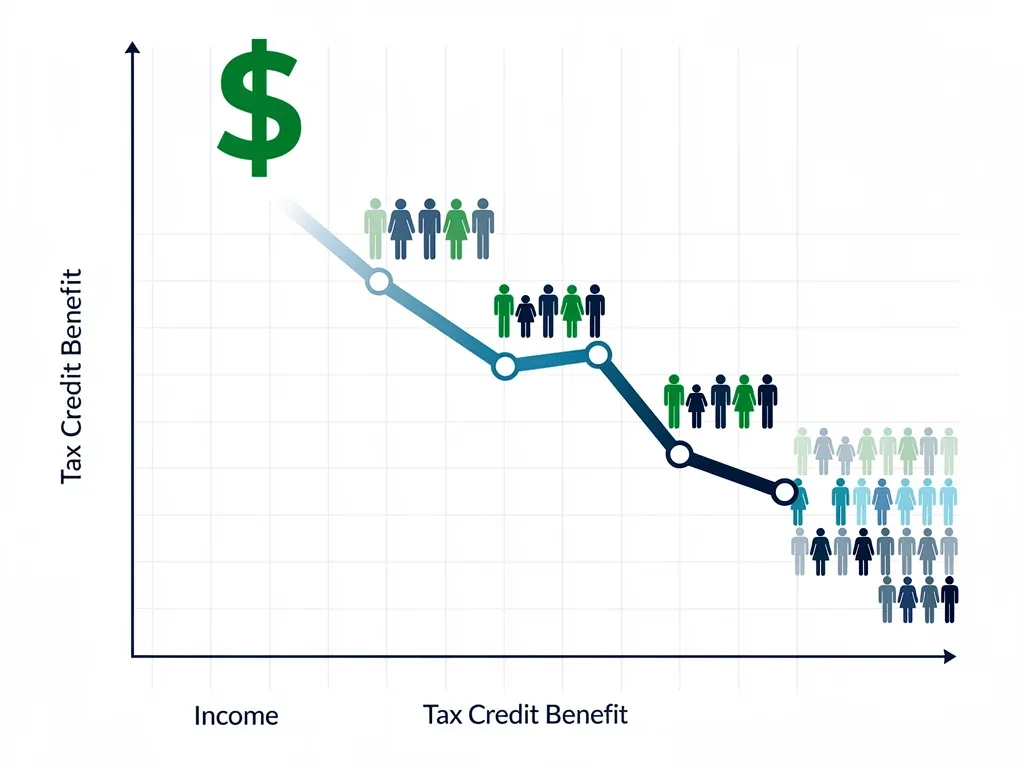
While the prospect of a $2,000 per child benefit is exciting, it’s crucial for families to understand how income phase-out rules can affect the actual amount they receive. The 2026 Child Tax Credit, like its predecessors, is designed to provide greater benefits to lower and middle-income families, with the credit gradually reducing as income rises above specific thresholds.
These phase-out rules are a standard feature of many tax credits, ensuring that the benefits are targeted. For families approaching or exceeding these income levels, careful planning and understanding are essential to accurately estimate their expected credit.
What are income phase-outs?
Income phase-outs are mechanisms in tax law that reduce the amount of a tax credit or deduction as a taxpayer’s income increases beyond a certain level. For the Child Tax Credit, this means that once your Modified Adjusted Gross Income (MAGI) surpasses a specific threshold, the $2,000 per child credit begins to decrease incrementally.
The goal is to prevent higher-income earners, who presumably need less financial assistance, from receiving the full benefit. This progressive reduction ensures that the tax credit remains fiscally responsible while still providing substantial support to a broad range of families.
Specific thresholds for 2026
For the 2026 tax year, the income phase-out thresholds for the Child Tax Credit are critical figures to remember:
- For married couples filing jointly, the credit begins to phase out when their MAGI exceeds $400,000.
- For all other filers (single, head of household, married filing separately), the phase-out begins when their MAGI exceeds $200,000.
It’s important to note that these thresholds are not cliffs where the credit disappears entirely. Instead, the credit is reduced by $50 for each $1,000 (or fraction thereof) by which your MAGI exceeds the applicable threshold. This gradual reduction ensures a smoother transition and avoids abrupt loss of benefits.
Families should calculate their MAGI carefully to determine where they stand relative to these thresholds. Tax software and professional tax preparers can be invaluable resources for this calculation, especially if your income is close to the phase-out limits. Understanding these thresholds and the reduction rate is key to accurately predicting your 2026 Child Tax Credit benefit.
Refundability: The Additional Child Tax Credit (ACTC)
While the core 2026 Child Tax Credit is primarily non-refundable, meaning it can reduce your tax liability to zero but not generate a refund beyond that, there’s a crucial component that allows some families to receive a portion of the credit as a refund: the Additional Child Tax Credit (ACTC). Understanding the ACTC is vital for lower-income families who may have little to no federal tax liability but still need financial support.
The ACTC acts as a safety net, ensuring that even if your tax bill is already zero, you can still benefit from a portion of the Child Tax Credit, providing much-needed cash flow directly to families.
Distinction between refundable and non-refundable credits
To fully grasp the ACTC, it’s important to differentiate between refundable and non-refundable tax credits:
- Non-refundable credits: These credits can reduce your tax liability to zero, but if the credit amount is more than your tax liability, you don’t get the difference back as a refund. The Child Tax Credit, up to $2,000 per child, is primarily non-refundable.
- Refundable credits: These credits can not only reduce your tax liability to zero but can also result in a refund if the credit amount exceeds your tax liability. The Additional Child Tax Credit is a partially refundable credit.
This distinction is significant because it determines whether a family receives a direct payment even if they owe no taxes. For many low-income households, refundable credits are a lifeline, offering financial assistance that non-refundable credits cannot.
How the ACTC works for 2026
For the 2026 tax year, the Additional Child Tax Credit allows eligible taxpayers to receive a refund of up to $1,600 per qualifying child, even if they owe no federal income tax. This amount is subject to specific income requirements.
To qualify for the ACTC, you must have earned income above a certain threshold, typically around $2,500. The refundable portion is calculated as 15% of your earned income that exceeds this threshold, up to the maximum refundable amount. This means that the more you earn (up to a point), the larger your potential ACTC refund.
The ACTC is particularly beneficial for working families with lower incomes. It acknowledges that even if a family’s tax liability is minimal, the costs of raising children persist. By providing a refundable portion, the ACTC ensures that the Child Tax Credit continues to serve its purpose of supporting families across the economic spectrum, offering a tangible financial boost when it’s most needed.
Calculating Your 2026 Child Tax Credit
Calculating your potential 2026 Child Tax Credit can seem daunting, but by breaking down the steps and understanding the key variables, you can arrive at a reasonable estimate. This process involves assessing your eligibility, determining your qualifying children, and factoring in your income levels relative to the phase-out thresholds.
Accurate calculation is crucial for effective financial planning, allowing you to anticipate your tax refund or reduce your tax liability with confidence. Let’s walk through the essential steps.
Step-by-step guide to estimating your credit
Follow these steps to estimate your 2026 Child Tax Credit:
- Determine Qualifying Children: For each child, verify they meet all the eligibility criteria: age (under 17), relationship, residency, support, and joint return tests.
- Calculate Base Credit: Multiply the number of qualifying children by $2,000. This is your maximum potential credit before any reductions.
- Calculate Modified Adjusted Gross Income (MAGI): Determine your MAGI. This is usually your AGI with certain deductions added back.
- Check for Phase-Out: Compare your MAGI to the phase-out thresholds ($400,000 for married filing jointly; $200,000 for all others).
- Apply Phase-Out Reduction (if applicable): If your MAGI exceeds the threshold, subtract the threshold from your MAGI. Divide this difference by $1,000 and multiply by $50. Subtract this amount from your base credit. The result is your non-refundable CTC.
- Determine Additional Child Tax Credit (ACTC): If your non-refundable CTC is less than your tax liability, you may be eligible for the ACTC. Calculate 15% of your earned income above $2,500, up to a maximum of $1,600 per child. This is the refundable portion.
Remember that tax laws can be complex, and these steps provide an estimate. For precise figures, consulting a tax professional or using reliable tax software is always recommended.
Tools and resources for accurate assessment
Several tools and resources can assist you in accurately assessing your 2026 Child Tax Credit:
- IRS Website: The official IRS website is the authoritative source for tax information, offering publications, FAQs, and potential calculators as the tax year approaches.
- Tax Software: Popular tax preparation software (e.g., TurboTax, H&R Block) are designed to guide you through the process, automatically calculating credits based on your entered information.
- Professional Tax Preparers: For complex financial situations or if you prefer expert assistance, a certified public accountant (CPA) or enrolled agent can provide personalized advice and ensure accuracy.
- Financial Planners: While not directly tax preparers, financial planners can help you understand how the CTC fits into your broader financial strategy.
Utilizing these resources can help ensure that you not only accurately calculate your credit but also understand its implications for your overall financial health. Staying informed and proactive is the best approach to maximizing your benefits.
Impact on Family Budgets and Financial Planning
The 2026 Child Tax Credit, with its potential $2,000 per child benefit, represents a significant financial boost for many American families. Understanding its impact and integrating it into your financial planning can lead to smarter budgeting decisions, improved savings, and enhanced long-term financial security.
This credit isn’t just about a single payment; it’s about the cumulative effect it can have on a family’s economic stability throughout the year. Thoughtful allocation of these funds can yield substantial benefits.
Strategizing with the CTC benefit
Receiving the Child Tax Credit provides an opportunity to strategically manage your family’s finances. Instead of viewing it as a windfall, consider how it can be best utilized to support your household’s goals:
- Reducing Debt: High-interest debt can be a significant burden. Using the CTC to pay down credit card balances or personal loans can free up monthly cash flow.
- Boosting Savings: Contributing to an emergency fund, a child’s college fund (529 plan), or a retirement account can strengthen your financial foundation.
- Essential Expenses: The credit can help cover rising costs of living, such as groceries, utilities, and childcare, alleviating immediate budgetary pressures.
- Home Improvements: Investing in necessary home repairs or energy-efficient upgrades can provide long-term value and savings.
By consciously deciding how to allocate these funds, families can transform the credit from a temporary relief into a tool for lasting financial improvement. This proactive approach ensures the benefit serves its intended purpose effectively.
Long-term financial implications
Beyond immediate relief, the 2026 Child Tax Credit can have significant long-term financial implications. For instance, consistently applying the credit towards savings or investments can lead to substantial growth over time. For younger families, starting a college fund with CTC funds can dramatically reduce future student loan burdens.
Moreover, for families struggling with financial instability, the credit can provide the necessary buffer to avoid high-interest predatory loans or to build a safety net that prevents them from falling into debt during unexpected crises. This stability fosters a healthier financial environment for children to grow up in.
The credit also indirectly supports local economies. When families have more disposable income, they are more likely to spend it on goods and services, stimulating economic activity. Thus, the CTC is not just a family benefit; it’s a broader economic stabilizer. Integrating the 2026 Child Tax Credit into a holistic financial plan allows families to leverage this government support for sustained economic well-being and future prosperity.
Potential Changes and Future Outlook for the CTC
Tax laws, including those governing the Child Tax Credit, are not static. They are subject to legislative changes, economic shifts, and evolving political priorities. While the 2026 Child Tax Credit maintains a consistent structure, it’s prudent for families to remain aware of potential future adjustments and the broader outlook for this crucial benefit.
Understanding the dynamics of tax policy can help families prepare for any modifications that might impact their financial planning in subsequent years. Proactive monitoring of legislative discussions is key.
Legislative landscape and reform discussions
The Child Tax Credit has frequently been a subject of congressional debate, particularly regarding its size, refundability, and eligibility criteria. Past reforms, such as the temporary expansion under the American Rescue Plan, demonstrated the potential for significant changes. While the 2026 credit reverts to a more traditional structure, discussions about future expansions or modifications are always ongoing.
Lawmakers often consider various proposals aimed at either increasing the credit’s value, expanding its refundability to more low-income families, or adjusting income thresholds. These debates are influenced by economic conditions, social policy goals, and fiscal considerations.
Keeping an eye on legislative developments, especially as new election cycles approach, can provide insights into potential changes that could affect the CTC in 2027 and beyond. Organizations focused on family advocacy and tax policy often provide valuable updates on these discussions.
Staying informed about updates
Given the dynamic nature of tax policy, staying informed is essential for families who rely on the Child Tax Credit. The IRS is the primary source for official information, but other reputable sources can help you track developments:
- IRS.gov: Regularly check the IRS website for official announcements, publications, and updated forms related to the Child Tax Credit.
- Reputable Financial News Outlets: Major financial news sources often cover tax policy debates and changes extensively.
- Tax Professionals: Your CPA or tax preparer can offer personalized advice and inform you of any changes that might specifically impact your family.
- Non-profit Advocacy Groups: Organizations focused on family welfare and tax fairness often provide clear summaries of proposed and enacted legislation.
By actively seeking out information from these sources, families can ensure they are always operating with the most current understanding of the Child Tax Credit. This preparedness allows for timely adjustments to financial plans, ensuring that families can continue to leverage this important benefit effectively, regardless of how the legislative landscape evolves.
| Key Aspect | Brief Description |
|---|---|
| Benefit Amount | Up to $2,000 per qualifying child for 2026. |
| Eligibility | Child must be under 17, meet relationship, residency, and support tests. |
| Income Phase-Outs | Starts at $400,000 (MFJ) and $200,000 (others), reducing credit by $50 per $1,000. |
| Refundability (ACTC) | Up to $1,600 per child may be refundable for eligible lower-income families. |
Frequently Asked Questions About the 2026 Child Tax Credit
What is the maximum Child Tax Credit amount for 2026?▼The maximum non-refundable Child Tax Credit for 2026 is $2,000 per qualifying child. Additionally, eligible families may receive up to $1,600 per child through the refundable Additional Child Tax Credit (ACTC), depending on their earned income and other factors.
What are the income limits for the 2026 Child Tax Credit?▼The 2026 Child Tax Credit begins to phase out for married couples filing jointly with a Modified Adjusted Gross Income (MAGI) over $400,000. For all other filers, the phase-out starts when their MAGI exceeds $200,000. The credit reduces by $50 for every $1,000 over these thresholds.
Can I receive the Child Tax Credit if I don’t owe any taxes?▼The primary $2,000 Child Tax Credit is non-refundable, meaning it can reduce your tax liability to zero but won’t result in a refund beyond that. However, through the Additional Child Tax Credit (ACTC), you may receive a refundable portion of up to $1,600 per child if you meet specific earned income requirements, even if you owe no tax.
What age does my child need to be to qualify for the 2026 CTC?▼To be a qualifying child for the 2026 Child Tax Credit, your child must be under the age of 17 (i.e., 16 years old or younger) at the end of the tax year, December 31, 2026. They must also meet other residency, relationship, and support tests.
How do I claim the 2026 Child Tax Credit?▼You claim the 2026 Child Tax Credit by filing your federal income tax return (Form 1040) and attaching Schedule 8812, Credits for Qualifying Children and Other Dependents. Ensure you provide accurate information about your qualifying children and income to claim the correct credit amount.
Conclusion
The 2026 Child Tax Credit stands as a vital component of financial support for American families, offering a substantial $2,000 per child benefit. Understanding the intricacies of its eligibility requirements, the impact of income phase-out thresholds, and the potential for refundability through the Additional Child Tax Credit is paramount for maximizing this valuable benefit. By carefully planning and staying informed, families can effectively integrate the CTC into their financial strategies, fostering greater stability and supporting their children’s well-being. As tax laws evolve, continuous engagement with reliable resources will ensure families remain empowered to make the most of this significant tax credit.