2026 Social Security COLA: What a 2.5% Increase Means
Advertisements
The 2026 Social Security Cost-of-Living Adjustment (COLA) is projected at 2.5%, impacting millions of beneficiaries by adjusting monthly payments to counteract inflation, ensuring their purchasing power is maintained amidst rising costs.
Understanding the 2026 Social Security Cost-of-Living Adjustment (COLA): What a 2.5% Increase Means for Beneficiaries is crucial for millions of Americans relying on these benefits. This adjustment directly influences the financial well-being of retirees, disabled individuals, and survivors, making it essential to grasp its mechanisms and potential impact on your personal finances.
Decoding the 2026 Social Security COLA: The Basics
The Social Security Cost-of-Living Adjustment, or COLA, is an annual increase in Social Security and Supplemental Security Income (SSI) benefits. Its primary purpose is to help beneficiaries maintain their purchasing power in the face of inflation. Without COLA, the fixed income of retirees and other beneficiaries would steadily lose value as the cost of goods and services rises, eroding their financial security over time.
The COLA is determined by the Social Security Administration (SSA) based on changes in the Consumer Price Index for Urban Wage Earners and Clerical Workers (CPI-W). This specific index measures the average change over time in the prices paid by urban wage earners and clerical workers for a market basket of consumer goods and services. The calculation typically compares the average CPI-W for the third quarter of the current year with the average for the third quarter of the previous year. The percentage increase, if any, then becomes the COLA for the following year.
How is COLA Calculated?
The process of determining COLA is precise and formulaic. The CPI-W data from July, August, and September are averaged. This average is then compared to the average CPI-W from the same three months of the prior year. The percentage difference, rounded to the nearest one-tenth of one percent, becomes the COLA for the upcoming year. If there is no increase, or if the CPI-W declines, there is no COLA for that year, ensuring benefits do not decrease.
- CPI-W Data: The specific inflation measure used by the SSA.
- Third Quarter Average: July, August, and September data are critical.
- Year-over-Year Comparison: Determines the percentage increase.
- No Decrease: COLA can be zero but never negative.
For 2026, a projected 2.5% COLA suggests that inflationary pressures are expected to continue, albeit at a potentially more moderate pace than in recent years. This percentage is not merely a number; it represents a tangible increase in the monthly income for millions of Americans, directly influencing their ability to afford necessities like food, housing, and healthcare. Understanding this mechanism is the first step in appreciating the broader implications of the 2026 Social Security COLA.
In essence, the COLA serves as a vital safeguard, protecting the economic stability of those who depend on Social Security. Its annual adjustment is a cornerstone of the program’s design, ensuring that benefits remain relevant and effective in an ever-changing economic landscape. The 2.5% projection for 2026 offers a glimpse into the anticipated economic environment and its direct impact on beneficiaries’ wallets.
The Impact of a 2.5% Increase on Beneficiaries’ Wallets
A 2.5% increase in Social Security benefits for 2026, while seemingly modest, translates into a tangible financial boost for millions of beneficiaries. This adjustment will directly affect the monthly checks received by retirees, individuals with disabilities, and survivors, influencing their budgeting and purchasing power. For someone receiving an average Social Security benefit, a 2.5% increase could mean several additional dollars each month, which can collectively make a significant difference over a year.
Consider an individual currently receiving $1,800 per month in Social Security benefits. A 2.5% COLA would add $45 to their monthly check, bringing their new benefit to $1,845. While $45 might not seem like a vast sum, for those living on a fixed income, every dollar counts. This extra income can help cover rising costs of everyday essentials, unexpected expenses, or even allow for small discretionary spending that might otherwise be out of reach.
Budgeting with the New COLA
Beneficiaries will need to factor this new adjustment into their personal budgets. The increase is designed to offset inflation, meaning that the additional funds are intended to help cover the higher costs of goods and services that have already occurred or are anticipated. Therefore, while their income rises, so too do the prices of what they buy.
- Healthcare Costs: A significant portion of senior expenses; COLA helps mitigate rising premiums and out-of-pocket costs.
- Food and Groceries: Everyday necessities often see price fluctuations; COLA provides relief.
- Housing Expenses: Rent, utilities, and property taxes can increase; COLA offers some buffer.
- Transportation: Fuel and vehicle maintenance costs can be partially covered by the increase.
It’s important to remember that the COLA is a general adjustment and may not perfectly align with every individual’s specific cost increases. For example, if a beneficiary’s healthcare costs rise by 5%, a 2.5% COLA will only partially cover that increase. However, without the COLA, the erosion of purchasing power would be even more severe. The 2026 Social Security COLA is a critical component of financial stability for many, providing a necessary, albeit often modest, buffer against economic shifts.
The cumulative effect of annual COLAs over a retirement period can be substantial. Even small percentage increases, compounded year after year, ensure that benefits retain much of their original value decades into retirement. This steady adjustment is fundamental to the long-term viability of Social Security as a primary income source for seniors and other eligible individuals.
Inflationary Pressures and the COLA Mechanism
The very existence of the Social Security Cost-of-Living Adjustment is a direct response to the persistent threat of inflation. Inflation, defined as the rate at which the general level of prices for goods and services is rising, erodes the purchasing power of money over time. For individuals on fixed incomes, like Social Security beneficiaries, inflation can be particularly devastating, as their income doesn’t automatically adjust to keep pace with rising costs. This is where the COLA mechanism steps in, acting as a vital shield against economic erosion.
The 2.5% projected COLA for 2026 reflects anticipated inflationary trends. It suggests that while the economy may be stabilizing, the cost of living is still expected to rise, necessitating an adjustment to benefits. The CPI-W, the index used for COLA calculations, is specifically chosen because it reflects spending patterns that are more representative of Social Security beneficiaries, focusing on categories like food, housing, medical care, and transportation. This targeted approach aims to ensure that the COLA accurately addresses the real-world expenses faced by these individuals.
Challenges and Criticisms of the CPI-W
While the CPI-W is the official measure, it’s not without its critics. Some argue that it doesn’t fully capture the unique spending patterns of seniors, who often spend a larger proportion of their income on healthcare compared to urban wage earners. This disparity can lead to a situation where the COLA, while helpful, may not entirely cover the actual cost increases experienced by the elderly.
- Healthcare Bias: CPI-W may underrepresent rising healthcare costs for seniors.
- Fixed Income Strain: Seniors have less flexibility to adjust spending habits.
- Alternative Indexes: Proposals exist for a CPI-E (Consumer Price Index for the Elderly) to better reflect senior expenses.
- Political Debate: The adequacy of COLA calculations is a recurring political topic.
Despite these criticisms, the current system remains the established method for determining the 2026 Social Security COLA and future adjustments. The 2.5% figure, therefore, is a direct reflection of the SSA’s assessment of how much prices are expected to rise for the demographic it serves. It’s a critical indicator not just of benefit increases, but also of the broader economic health and inflationary environment within the United States.
Understanding the interplay between inflation and COLA is fundamental to comprehending the purpose and importance of these annual adjustments. They are not merely arbitrary increases but carefully calculated responses designed to preserve the financial dignity and stability of millions of Americans who have contributed to the Social Security system throughout their working lives. The 2.5% COLA for 2026 underscores the ongoing need for such protective measures.
Who Benefits from the 2026 COLA Increase?
The 2026 Cost-of-Living Adjustment will extend its financial reach to a broad spectrum of individuals across the United States. While often associated primarily with retirees, Social Security benefits support a much wider demographic. Understanding who qualifies for this increase helps to illustrate the program’s extensive impact on American families and communities. Essentially, anyone receiving Social Security benefits or Supplemental Security Income (SSI) will see their payments adjusted by the 2.5% COLA.
This includes retired workers, who constitute the largest group of beneficiaries. For them, the COLA ensures that their hard-earned retirement savings, supplemented by Social Security, retain their value over time. However, the benefits extend significantly beyond this group. Disabled workers and their families also rely heavily on these payments, and the COLA provides crucial support to help them manage their daily living expenses and medical costs.
Diverse Beneficiary Groups
Beyond retirees and disabled workers, several other categories of individuals will also experience the positive effects of the 2.5% COLA:
- Survivors: Widows, widowers, and children of deceased workers receive benefits to help them cope with the loss of income. The COLA helps these families maintain their standard of living.
- Spouses: Spouses of retired or disabled workers may receive benefits based on their partner’s earnings record. These benefits also increase with COLA.
- Children: Dependent children of retired, disabled, or deceased workers can receive benefits, which are also subject to the annual COLA.
- SSI Recipients: Individuals receiving Supplemental Security Income, a needs-based program administered by the SSA, will also see their payments adjusted.
The broad reach of the 2026 Social Security COLA highlights the program’s foundational role in the social safety net of the United States. It’s not just about retirement; it’s about providing a financial lifeline to millions of vulnerable citizens, ensuring they can afford essential goods and services as prices inevitably rise. The 2.5% adjustment for 2026 underscores the continuous effort to keep these benefits relevant and effective for all eligible recipients.
From young children whose parents have passed away to centenarians who have been receiving benefits for decades, the COLA touches nearly every stage of life where Social Security provides support. This universal application within the beneficiary groups reinforces the program’s commitment to protecting the financial stability of those who rely on it most.
Planning for the Future: 2026 COLA in Your Retirement Strategy
Integrating the projected 2.5% 2026 Social Security COLA into your long-term retirement strategy is a pragmatic approach to financial planning. While Social Security is a vital component of most retirement incomes, it’s rarely sufficient on its own. Understanding how COLA works and its potential impact allows individuals to make more informed decisions about their savings, investments, and overall financial health. The COLA helps to preserve purchasing power, but it should not be the sole basis of your inflation-proofing strategy.
Financial planners often emphasize the importance of diversified income streams in retirement. Relying solely on Social Security, even with annual COLA adjustments, can leave retirees vulnerable to unexpected expenses or higher-than-average inflation in specific sectors like healthcare. Therefore, the 2.5% COLA should be viewed as a baseline adjustment, a foundational element upon which to build a robust financial plan.
Strategies for Supplementing COLA
To truly secure your financial future, consider supplementing your Social Security benefits with other income sources and inflation-protected investments. This proactive approach can help ensure your lifestyle isn’t solely dependent on the annual COLA percentage.
- Personal Savings: Building a substantial nest egg through 401(k)s, IRAs, and other investment vehicles.
- Inflation-Protected Securities: Investing in Treasury Inflation-Protected Securities (TIPS) or other assets designed to hedge against inflation.
- Part-Time Work: Continuing to work part-time in retirement can provide additional income and social engagement.
- Annuities: Certain types of annuities can offer guaranteed income streams that may also have inflation adjustments.
When projecting future income, it’s wise to use conservative COLA estimates, as the actual percentage can fluctuate based on economic conditions. While 2.5% is projected for 2026, future years could see higher or lower adjustments. By planning for a slightly lower COLA than anticipated, you create a buffer that can absorb unexpected financial shocks and provide greater peace of mind. The COLA is a valuable tool, but it’s part of a larger financial ecosystem.
Incorporating the COLA into your retirement strategy means acknowledging its role in maintaining your standard of living while also actively seeking ways to enhance and protect your financial resources independently. This dual approach ensures that you are not only adapting to economic changes but also proactively shaping your financial future.
Historical Context: COLA Trends and Economic Factors
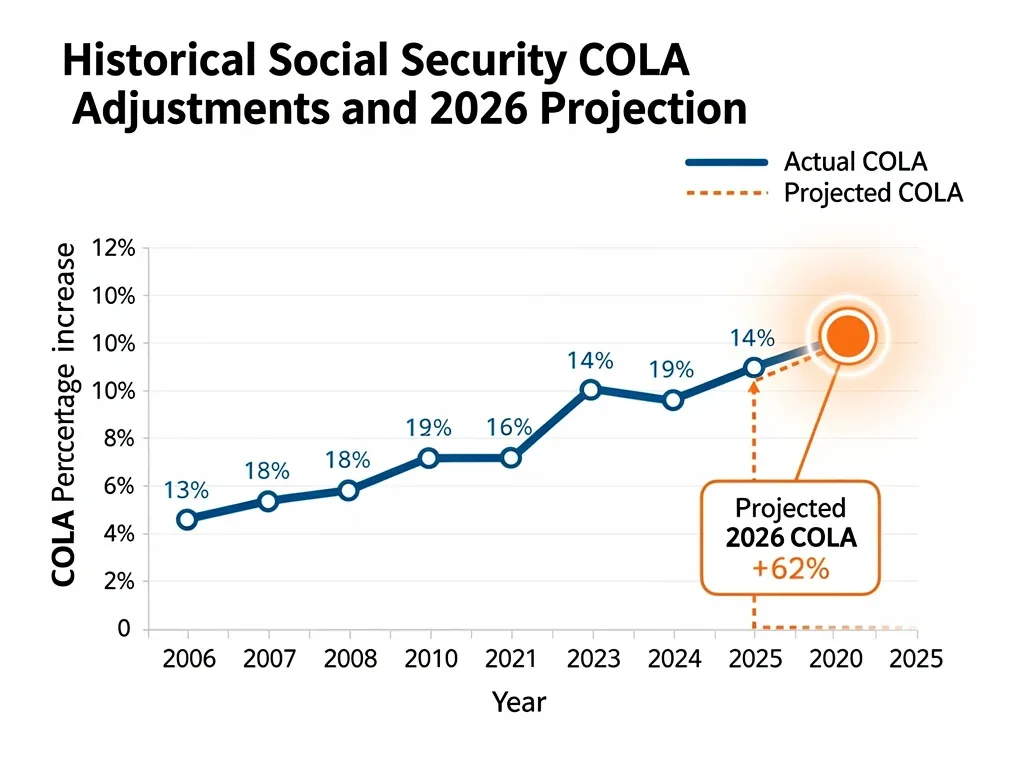
Examining the historical context of Social Security COLA adjustments provides valuable insights into the economic factors that drive these changes and helps to put the projected 2.5% increase for 2026 into perspective. Over the decades, COLA percentages have varied significantly, reflecting periods of high inflation, economic stability, and even deflationary concerns. These trends are directly tied to the broader economic landscape, particularly consumer price movements.
In periods of high inflation, such as the late 1970s and early 1980s, COLAs were exceptionally high, sometimes reaching double-digit percentages, to protect beneficiaries’ purchasing power. Conversely, during periods of low inflation or economic stagnation, COLAs have been minimal or even zero, as seen in 2009, 2010, and 2015 when the CPI-W showed no increase. This historical variability underscores the dynamic nature of the COLA mechanism and its sensitivity to economic conditions.

Factors Influencing COLA Variability
Several key economic factors play a crucial role in determining the annual COLA. Understanding these influences can help beneficiaries and planners anticipate future adjustments.
- Energy Prices: Fluctuations in oil and gas prices significantly impact the CPI-W, as energy is a major component of consumer spending.
- Food Costs: Changes in agricultural output, supply chain issues, and global demand affect food prices, another substantial part of the CPI-W.
- Housing Market: Rent and homeowner equivalent rent components within the CPI-W are influenced by the real estate market.
- Global Economic Events: Geopolitical events, trade policies, and international economic shifts can indirectly affect domestic inflation.
The 2.5% projection for the 2026 Social Security COLA suggests a return to more moderate, yet still present, inflationary conditions compared to the higher COLAs seen in the early 2020s. This moderation could be attributed to various factors, including Federal Reserve policies aimed at controlling inflation, easing supply chain pressures, or a rebalancing of consumer demand. Historical data confirms that COLAs are not static; they are a living reflection of the economy’s pulse.
Analyzing these past trends provides a clearer picture of what beneficiaries can expect and how their benefits are designed to adapt. It reinforces the idea that Social Security is not a static payment but a dynamic system responsive to the economic realities faced by its recipients, continually striving to maintain their financial stability.
Navigating Future Financial Landscape with the 2026 COLA
Navigating the financial landscape of the future requires a clear understanding of how adjustments like the 2026 Social Security COLA fit into the broader economic outlook. While the 2.5% increase offers a degree of financial relief, beneficiaries must consider it within the context of ongoing economic shifts, potential policy changes, and personal financial goals. The COLA is a reactive measure, responding to past inflation, but proactive financial planning remains essential.
Looking ahead, factors such as the solvency of the Social Security trust funds, demographic changes, and future legislative actions could all influence the long-term outlook for benefits. While the COLA mechanism itself is enshrined in law, the broader financial health of the system is subject to continuous debate and potential reforms. Therefore, relying solely on COLA to maintain financial stability without considering other variables would be short-sighted.
Beyond the Annual Adjustment
To effectively navigate the future, beneficiaries and those nearing retirement should consider a holistic approach that goes beyond just the annual COLA percentage. This involves understanding potential changes to Medicare premiums, income tax implications of increased benefits, and the impact of personal savings and investments.
- Medicare Premiums: Often deducted directly from Social Security benefits, these can rise and offset some of the COLA increase.
- Taxable Income Thresholds: Higher Social Security benefits can push some individuals into higher income tax brackets or make a larger portion of their benefits taxable.
- Long-Term Care Planning: The COLA does not directly address the escalating costs of long-term care, which require separate financial planning.
- Estate Planning: Ensuring your financial legacy is robust and adaptable to future economic conditions.
The 2.5% COLA for 2026 serves as a valuable reminder that economic conditions are constantly evolving. It encourages beneficiaries to remain vigilant about their finances, to seek professional advice when needed, and to continuously adapt their strategies. The goal is not just to receive an increased benefit but to ensure that increase contributes effectively to a secure and comfortable future, regardless of economic uncertainties.
Ultimately, the COLA is a tool designed to help. Its effectiveness, however, is maximized when combined with prudent personal financial management and a clear understanding of the broader economic and policy environment affecting Social Security. This comprehensive view empowers beneficiaries to make the most of their increased benefits and plan confidently for the years to come.
| Key Point | Brief Description |
|---|---|
| 2026 COLA Projection | Social Security benefits are projected to increase by 2.5% for 2026, aimed at offsetting inflation. |
| Beneficiary Impact | Millions of retirees, disabled individuals, and survivors will see a direct increase in their monthly payments. |
| Inflation Shield | COLA helps maintain purchasing power against rising costs of goods and services, calculated via CPI-W. |
| Financial Planning | Beneficiaries should integrate COLA into their budget, but also consider supplementary income and inflation hedges. |
Frequently Asked Questions about the 2026 COLA
What is the primary purpose of the Social Security COLA?▼The primary purpose of the Social Security Cost-of-Living Adjustment (COLA) is to protect the purchasing power of beneficiaries. It ensures that Social Security and SSI benefits keep pace with inflation, preventing their value from eroding over time due to rising costs of goods and services. This helps maintain financial stability for millions of Americans.
How is the 2026 COLA percentage determined?▼The 2026 COLA, like all COLAs, is determined by comparing the average Consumer Price Index for Urban Wage Earners and Clerical Workers (CPI-W) for the third quarter (July, August, September) of the current year with the average for the same period of the previous year. The percentage increase, if any, becomes the COLA.
Will my Medicare premiums impact my 2026 COLA increase?▼Yes, Medicare Part B premiums are typically deducted directly from Social Security benefits. While your gross benefit will increase by the 2.5% COLA, any rise in Medicare premiums could offset some of that increase, potentially resulting in a smaller net gain in your monthly Social Security check. It’s important to monitor both.
Are all Social Security beneficiaries eligible for the 2026 COLA?▼Yes, generally all individuals receiving Social Security benefits, including retired workers, disabled workers, survivors, and dependents, as well as Supplemental Security Income (SSI) recipients, are eligible for the annual COLA. The 2.5% increase for 2026 will apply across these beneficiary groups, ensuring broad coverage and support.
What if inflation is higher than the 2.5% COLA in 2026?▼If actual inflation, as experienced by beneficiaries, is higher than the 2.5% COLA, their purchasing power could still slightly diminish. The COLA is an average adjustment based on the CPI-W, which may not perfectly capture every individual’s unique spending patterns, especially concerning rapidly rising costs in specific sectors like healthcare.
Conclusion
The projected 2.5% 2026 Social Security COLA represents a vital adjustment designed to help millions of Americans maintain their financial footing against the backdrop of ongoing inflation. While it provides a necessary boost to monthly benefits for retirees, disabled individuals, and survivors, it also serves as a crucial reminder of the importance of comprehensive financial planning. Understanding the mechanics of COLA, its historical context, and its potential impact allows beneficiaries to integrate this adjustment into a broader strategy that ensures long-term financial security, moving beyond mere reliance on annual increases to proactively manage their economic future.