2026 AMT Thresholds: Avoid Unexpected Tax Bills
Advertisements
The 2026 Alternative Minimum Tax (AMT) thresholds are set to impact a broader range of taxpayers, necessitating careful financial planning to circumvent unforeseen tax burdens and optimize fiscal outcomes.
Are you prepared for the potential impact of The 2026 Alternative Minimum Tax (AMT) Thresholds: Avoiding Unexpected Tax Bills? Many high-income earners find themselves unexpectedly ensnared by the AMT, a parallel tax system designed to ensure that certain taxpayers pay a minimum amount of tax, regardless of deductions and credits. Understanding these thresholds and implementing proactive strategies is paramount to safeguarding your financial well-being and preventing unpleasant surprises when tax season arrives.
Understanding the Alternative Minimum Tax (AMT) in 2026
The Alternative Minimum Tax (AMT) is a separate tax calculation that runs parallel to the regular income tax system. Its purpose is to ensure that individuals, estates, and trusts who benefit from certain tax preferences still pay at least a minimum amount of tax. For 2026, the AMT continues to evolve, with updated thresholds and exemptions that can significantly alter a taxpayer’s liability.
Originally enacted in 1969 to prevent a small number of high-income individuals from using deductions and loopholes to avoid paying any income tax, the AMT has since broadened its reach. While the Tax Cuts and Jobs Act (TCJA) of 2017 significantly reduced the number of taxpayers subject to AMT by increasing exemption amounts and phasing out thresholds, it remains a critical consideration for many. As we approach 2026, it’s essential to recognize that inflation adjustments and potential legislative changes could bring more individuals back into the AMT’s purview.
The mechanics of AMT calculation
Calculating the AMT involves a series of adjustments to your regular taxable income. These adjustments often add back certain deductions and exclusions that are allowed under the regular tax system. Once these adjustments are made, you arrive at your Alternative Minimum Taxable Income (AMTI). The AMTI is then subject to an AMT exemption, which is a specific amount that is exempt from the AMT. This exemption amount phases out at higher income levels, meaning that wealthier taxpayers receive a reduced or no exemption.
- Regular Taxable Income: Your starting point from your standard tax calculation.
- AMT Adjustments: Additions for items like state and local income taxes (SALT), certain depreciation, and incentive stock options (ISOs).
- AMT Preferences: Specific income items that receive preferential tax treatment under regular tax law but are included in AMTI.
- AMT Exemption: A fixed amount subtracted from AMTI, which phases out at higher income levels.
After applying the exemption, the remaining AMTI is taxed at two AMT rates: 26% and 28%. The 26% rate applies to a lower bracket of AMTI, while the 28% rate applies to AMTI above a certain threshold. The final AMT liability is then compared to your regular tax liability; if the AMT is higher, you pay the AMT amount. This complex calculation underscores why understanding the thresholds for 2026 is so vital for effective financial planning.
In conclusion, the AMT is not merely a historical footnote but a relevant aspect of the tax code that can significantly impact high-income earners. The intricate nature of its calculation, coupled with the potential for its reach to expand in 2026, demands a thorough understanding and proactive approach to tax planning. Ignoring the AMT can lead to unexpected tax bills and undermine otherwise sound financial strategies.
Key 2026 AMT Thresholds and Exemption Amounts
As we look ahead to 2026, the specific thresholds and exemption amounts for the Alternative Minimum Tax (AMT) will be crucial data points for tax planning. While exact figures are subject to inflation adjustments and potential legislative changes, understanding the general structure and how these numbers are derived is essential. These figures determine who is likely to be subject to the AMT and to what extent.
The AMT exemption amount is a key component. This is the portion of your Alternative Minimum Taxable Income (AMTI) that is not subject to the AMT. For 2026, these exemption amounts are expected to be adjusted for inflation, providing a slight increase from previous years. However, the crucial aspect is the phase-out threshold. As your AMTI exceeds a certain level, the exemption amount begins to decrease, eventually disappearing entirely for very high-income earners.
Projected exemption amounts for 2026
Based on current projections and historical inflation adjustments, the AMT exemption amounts for 2026 are anticipated to be higher than those in 2025. For single filers and married individuals filing separately, the exemption could be in the range of $86,000 to $88,000. For married couples filing jointly and qualifying widow(er)s, this amount might range from $134,000 to $136,000. These figures are estimates, and taxpayers should always refer to the official IRS guidance for the definitive amounts once they are released.
- Single Filers: Estimated $86,000 – $88,000
- Married Filing Jointly: Estimated $134,000 – $136,000
- Phase-out Thresholds: Begin at significantly higher AMTI levels, causing the exemption to diminish by 25 cents for every dollar over the threshold.
The phase-out thresholds are equally important. For single filers, the exemption typically begins to phase out when AMTI reaches approximately $578,000, while for married couples filing jointly, this threshold is around $1,156,000. Exceeding these thresholds means your effective AMT exemption is reduced, increasing your AMTI and potentially your AMT liability. This mechanism ensures that the AMT primarily targets higher-income individuals.
Understanding these projected 2026 AMT thresholds and exemption amounts is foundational for any effective tax planning strategy. While the exact figures will be confirmed by the IRS, having a strong grasp of the expected ranges allows individuals and financial advisors to model potential tax scenarios and identify strategies to mitigate the AMT’s impact well in advance. This foresight is invaluable in avoiding unexpected tax bills and optimizing overall financial outcomes.
Common Income and Deductions Affected by AMT
One of the primary reasons taxpayers are surprised by the Alternative Minimum Tax (AMT) is its treatment of certain income items and deductions that are handled differently under the regular tax system. What might be a beneficial deduction or an ordinary income event under standard rules can become an AMT adjustment, significantly increasing your Alternative Minimum Taxable Income (AMTI).
The key to understanding AMT exposure lies in identifying these specific items. High-income individuals, especially those with complex financial portfolios or specific types of compensation, are more likely to encounter these adjustments. Being aware of these areas allows for more targeted tax planning and helps in forecasting potential AMT liabilities before they become a problem.
Incentive stock options (ISOs)
Incentive Stock Options (ISOs) are a significant trigger for the AMT. While the bargain element (the difference between the fair market value of the stock and the exercise price) is not taxed for regular tax purposes when you exercise ISOs, it is included in your AMTI. This means that even if you don’t sell the stock immediately, the act of exercising ISOs can create a substantial AMT liability. This is a common pitfall for employees of rapidly growing companies, who might exercise options with a high bargain element but then find themselves with a large AMT bill without corresponding cash flow from a sale.
- Bargain Element: Included in AMTI upon exercise, not sale.
- Timing is Key: Exercising and holding ISOs can lead to significant AMT without liquidity.
- Cash Flow Planning: Ensure you have sufficient funds to cover potential AMT liability if you plan to hold ISO stock.
State and local taxes (SALT)
Another major AMT adjustment involves state and local income taxes (SALT). Under the regular tax system, individuals can deduct up to $10,000 for state and local income, sales, and property taxes. However, for AMT purposes, this deduction is largely disallowed. This means that the full amount of state and local taxes you paid, which might have been partially deductible for regular tax, is added back to your income when calculating your AMTI. This adjustment disproportionately affects residents of high-tax states, pushing more of them into the AMT.
Other deductions and income items that can trigger the AMT include certain interest on private activity bonds, accelerated depreciation on real and personal property, and passive activity losses. While some of these are less common for the average taxpayer, they can still contribute to an AMT liability for those with specific investments or business structures. The cumulative effect of these adjustments can quickly push a taxpayer’s income above the AMT exemption phase-out thresholds, leading to an unexpected tax bill.

In summary, understanding which income and deduction items are treated differently under the AMT is crucial. ISOs and the disallowance of the SALT deduction are particularly common culprits, but a thorough review of your financial situation and potential AMT adjustments is always recommended. Proactive identification of these items allows for strategic planning to minimize or avoid the AMT’s impact.
Proactive Strategies to Avoid Unexpected AMT Bills
Avoiding an unexpected Alternative Minimum Tax (AMT) bill in 2026 requires more than just a basic understanding of the thresholds; it demands proactive and strategic tax planning. Waiting until tax season to assess your AMT exposure can leave you with limited options and potentially significant liabilities. The key is to implement strategies throughout the year that manage your income and deductions in a way that minimizes AMTI.
Effective AMT planning often involves a delicate balance between accelerating certain deductions and deferring specific income, all while keeping a close eye on your projected AMTI. This type of planning is best done with the guidance of a qualified tax professional who can analyze your unique financial situation and tailor strategies specifically for you.
Managing incentive stock options (ISOs) strategically
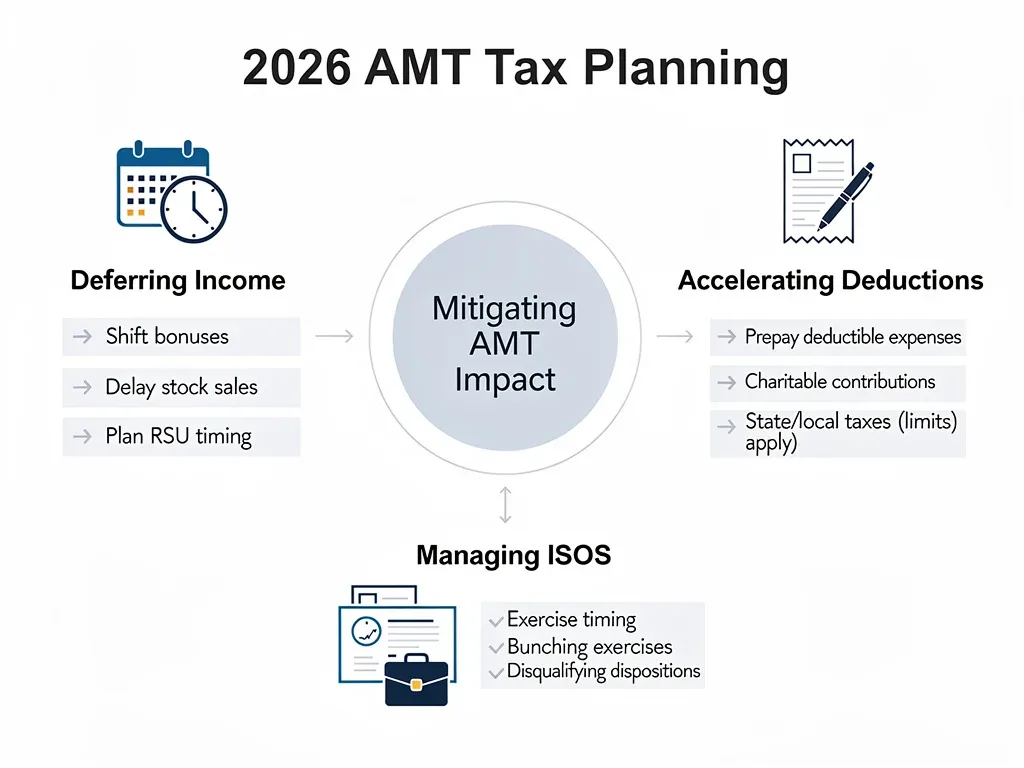
For those with Incentive Stock Options (ISOs), strategic management is paramount. Since the bargain element of ISOs is an AMT adjustment upon exercise, timing your exercises can make a significant difference. Consider a “disqualifying disposition” where you sell the stock within two years of the grant date or one year of the exercise date. While this makes the gain taxable as ordinary income for regular tax purposes, it eliminates the AMT adjustment in many cases.
- Stagger Exercises: Spread out ISO exercises over several years to avoid a large AMT hit in a single year.
- Disqualifying Dispositions: Evaluate if selling stock quickly makes sense to avoid AMT, despite ordinary income treatment.
- Cash Flow Planning: Ensure you have sufficient funds to cover potential AMT liability if you plan to hold ISO stock.
Accelerating deductions and deferring income
Another common strategy involves accelerating deductions and deferring income. If you anticipate being subject to the AMT in 2026, it might be beneficial to accelerate certain deductible expenses into that year. This could include making additional charitable contributions, prepaying state income taxes (though this specific deduction is often disallowed for AMT, so careful analysis is needed), or accelerating other deductible items. Conversely, deferring income into a year where you expect to be out of AMT can also reduce your current AMTI.
For instance, if you have control over the timing of bonuses or other forms of compensation, discussing the possibility of deferring a portion until 2027 might be a viable option. Similarly, managing capital gains and losses can also play a role. While capital gains are generally treated the same for both regular tax and AMT, realizing losses in an AMT year can help offset gains and reduce overall taxable income. The goal is to smooth out your income and deductions to avoid significant spikes that could trigger or exacerbate an an AMT liability.
In essence, proactive AMT planning is about foresight and strategic timing. By carefully managing ISO exercises, accelerating deductions, and deferring income when appropriate, taxpayers can significantly reduce their exposure to the AMT and avoid the unwelcome surprise of a higher-than-expected tax bill in 2026. Consulting a tax professional for personalized advice is always the best course of action.
Impact of TCJA on 2026 AMT Landscape
The Tax Cuts and Jobs Act (TCJA) of 2017 brought about significant changes to the tax landscape, and its impact on the Alternative Minimum Tax (AMT) cannot be overstated, even as we look towards 2026. While the TCJA did not eliminate the AMT, it drastically reduced its reach, making it less likely for many middle and upper-middle-income taxpayers to be subject to it. However, understanding the sunset provisions of the TCJA is crucial, as some of its changes are temporary and could revert in the future.
The primary way the TCJA mitigated the AMT’s impact was by substantially increasing the AMT exemption amounts and raising the income thresholds at which these exemptions begin to phase out. This meant that a much higher level of income was required before an individual would even begin to calculate their AMT liability. Consequently, millions of taxpayers who previously paid AMT found themselves no longer subject to it.
Increased exemption amounts and phase-out thresholds
Before the TCJA, the AMT was often referred to as a “middle-class tax” because its thresholds were not indexed sufficiently for inflation, causing it to ensnare more taxpayers than originally intended. The TCJA addressed this by significantly boosting the exemption amounts. For example, for a married couple filing jointly, the exemption jumped from around $84,500 in 2017 to $109,400 in 2018, and has continued to increase with inflation since then. The phase-out thresholds also saw substantial increases, moving from around $160,900 for joint filers in 2017 to over $1,000,000 in 2018.
- Higher Exemptions: Significantly reduced the number of taxpayers affected.
- Increased Phase-Outs: Pushed the AMT’s reach further up the income ladder.
- Temporary Provisions: Most TCJA provisions affecting individuals are set to expire after 2025.
Sunset provisions and future considerations
The critical point for 2026 is that many of the individual tax provisions of the TCJA, including the increased AMT exemption amounts and phase-out thresholds, are set to expire on December 31, 2025. This means that without new legislation, the AMT rules could revert to their pre-TCJA structure, potentially bringing a much larger segment of the population back into AMT exposure. This sunset provision creates significant uncertainty for tax planning in 2026 and beyond.
While it is possible that Congress will extend or make permanent some of these provisions, taxpayers and financial advisors must prepare for the possibility of reversion. This could mean a substantial increase in AMT liability for individuals who have grown accustomed to not owing AMT under the TCJA’s more generous rules. Therefore, staying informed about legislative developments and planning for various scenarios will be paramount as 2026 approaches.
In conclusion, the TCJA fundamentally reshaped the AMT landscape, making it less prevalent for many. However, the temporary nature of these changes means that 2026 could see a significant shift, potentially exposing more taxpayers to the AMT. Understanding these dynamics and preparing for potential reversion is a crucial aspect of navigating the future tax environment.
Tools and Resources for AMT Planning
Navigating the complexities of the Alternative Minimum Tax (AMT) for 2026 requires more than just a general understanding; it demands access to reliable tools and resources. Fortunately, a variety of options are available to help taxpayers and financial professionals accurately assess AMT exposure, project liabilities, and develop effective mitigation strategies. These resources range from official government publications to sophisticated tax software and expert financial advice.
The right tools can demystify the AMT calculation process, allowing individuals to make informed decisions about their financial future. Without these resources, the likelihood of facing an unexpected AMT bill increases significantly, potentially disrupting long-term financial goals and creating unnecessary stress during tax season.
IRS publications and forms
The Internal Revenue Service (IRS) is the primary source for official and accurate information regarding the AMT. Their publications and forms provide detailed instructions and explanations of how the AMT is calculated, the relevant thresholds, and the specific adjustments and preferences. IRS Publication 17, “Your Federal Income Tax,” and Publication 525, “Taxable and Nontaxable Income,” often contain sections dedicated to the AMT. Additionally, Form 6251, “Alternative Minimum Tax – Individuals,” is the official form used to calculate AMT liability and is an invaluable resource for understanding the mechanics.
- IRS Publication 17: Comprehensive guide to federal income tax, including AMT.
- Form 6251: The official calculation form for individual AMT.
- IRS Website: Up-to-date information, FAQs, and official guidance.
Tax software and financial advisors
Beyond official IRS resources, modern tax software plays a crucial role in AMT planning. Programs like TurboTax, H&R Block Tax Software, and professional-grade tax preparation software are designed to automatically calculate AMT liability based on your inputted financial data. These tools can run various scenarios, allowing you to see how different financial decisions (e.g., exercising ISOs, making large charitable donations) might impact your AMT.
However, while software is powerful, it cannot replace the expertise of a qualified financial advisor or tax professional. These experts possess a deep understanding of tax law, stay abreast of legislative changes, and can provide personalized advice tailored to your specific financial situation. They can help you interpret complex AMT rules, identify potential pitfalls, and devise sophisticated strategies that might not be obvious through software alone. A professional can also help you project your AMTI for future years, which is critical for long-term planning, especially considering the sunset provisions of the TCJA.
In conclusion, leveraging a combination of official IRS resources, advanced tax software, and the invaluable guidance of financial advisors is the most effective approach to AMT planning for 2026. These tools and experts empower taxpayers to navigate the intricate AMT landscape with confidence, ensuring they are well-prepared to avoid unexpected tax bills and optimize their financial outcomes.
Case Studies: Real-World AMT Scenarios
To truly grasp the implications of the Alternative Minimum Tax (AMT) thresholds in 2026, it’s often helpful to examine real-world scenarios. These case studies illustrate how different financial situations can unexpectedly trigger AMT liability, even for individuals who might not consider themselves exceptionally wealthy. By understanding these examples, taxpayers can better identify their own potential risks and apply proactive planning strategies.
The complexity of the AMT means that a seemingly straightforward financial decision, such as exercising stock options or living in a high-tax state, can have unforeseen consequences. These case studies highlight the importance of holistic tax planning that considers both regular tax and AMT implications simultaneously.
Case study 1: The tech executive and ISOs
Consider Sarah, a tech executive in California. In 2025, her company went public, and she exercised a significant number of Incentive Stock Options (ISOs) with a large bargain element, amounting to $500,000. For regular tax purposes, this exercise wasn’t a taxable event. However, for AMT purposes, the $500,000 bargain element was added back to her income. Combined with her high salary and state income taxes (which are largely disallowed for AMT), her AMTI soared past the 2026 exemption phase-out threshold. Although her regular tax liability was moderate due to other deductions, her AMT calculation resulted in an unexpected $80,000 tax bill, largely due to the ISO exercise. Sarah had not sold the stock, so she faced a substantial tax payment without corresponding cash flow, a classic AMT trap.
- Trigger: Large ISO exercise with high bargain element.
- Impact: Significant AMT liability without immediate liquidity.
- Lesson: Strategic ISO exercise timing and cash flow planning are critical.
Case study 2: The high-earning couple in a high-tax state
John and Mary, a married couple living in New York, collectively earn $450,000 per year. They own a home with substantial property taxes and pay significant state and local income taxes, totaling $45,000 annually. Under regular tax rules, they could deduct $10,000 of these SALT expenses. However, for AMT purposes, the entire $45,000 was added back to their AMTI. This adjustment, combined with their already high income, pushed their AMTI above the 2026 phase-out threshold for married couples. While they had no ISOs, the disallowance of their SALT deduction created an AMT liability of $15,000 that they had not anticipated.
These case studies underscore that AMT exposure is not limited to billionaires. High-income professionals, especially those with specific types of compensation like ISOs or those residing in high-tax states, are particularly vulnerable. The key takeaway is the necessity of early and comprehensive tax planning. By modeling potential AMT scenarios and understanding how different financial events interact with the AMT system, individuals like Sarah, John, and Mary could have implemented strategies to mitigate or even avoid these unexpected tax bills.
In conclusion, real-world examples serve as powerful reminders of the AMT’s potential impact. They illustrate that proactive planning, tailored to individual circumstances, is not just advisable but essential for navigating the complex tax landscape of 2026 and preventing unforeseen financial burdens.
Future Outlook and Legislative Considerations for AMT
The future of the Alternative Minimum Tax (AMT) beyond 2026 is shrouded in a degree of uncertainty, primarily due to the sunset provisions of the Tax Cuts and Jobs Act (TCJA) of 2017. As we approach the end of 2025, many individual tax provisions are set to expire, which could significantly alter the AMT landscape. Understanding these legislative considerations and potential future changes is vital for long-term financial planning.
The expiration of TCJA provisions means that the higher AMT exemption amounts and phase-out thresholds could revert to their pre-TCJA levels, adjusted for inflation. This reversion would likely bring a substantial number of additional taxpayers back into the AMT’s reach, including many who have not had to consider it for years. The political climate and economic conditions will heavily influence whether Congress acts to extend, modify, or allow these provisions to expire.
Potential legislative changes and debates
The debate surrounding the AMT and the TCJA’s sunset provisions will likely be a significant topic in Washington. There are various perspectives on how to proceed. Some policymakers may advocate for making the current, more generous AMT exemptions permanent, arguing that they simplify the tax code and reduce the burden on middle and upper-middle-income earners. Others might push for further reforms, or even the outright repeal of the AMT, citing its complexity and unintended consequences.
- TCJA Sunset: Key individual provisions, including AMT adjustments, expire after 2025.
- Congressional Debate: Potential for extension, modification, or full reversion to pre-TCJA rules.
- Economic Impact: Future legislation will be influenced by economic conditions and budget priorities.
Preparing for different scenarios
Given this legislative uncertainty, taxpayers and financial advisors must prepare for different scenarios. It is prudent to model tax liabilities under both the current (TCJA-influenced) AMT rules and the potential pre-TCJA rules. This dual-scenario planning allows for flexibility and helps identify strategies that are robust regardless of the legislative outcome. For instance, strategies like managing ISO exercises carefully, which are beneficial under both sets of rules, become even more critical.
Staying informed about political developments and tax reform proposals will be key. Financial news outlets, professional tax organizations, and reputable financial advisors can provide updates on legislative progress. This ongoing vigilance enables individuals to adapt their financial plans in real-time, ensuring they are always positioned to minimize their tax burden and avoid unexpected bills, regardless of how the AMT evolves after 2026.
In conclusion, the future of the AMT is intertwined with the fate of the TCJA’s sunset provisions. While uncertainty prevails, proactive preparation for various legislative outcomes is the most effective approach. By staying informed and engaging in flexible tax planning, individuals can navigate the evolving tax landscape and secure their financial well-being beyond 2026.
| Key Aspect | Brief Description |
|---|---|
| AMT Purpose | Ensures high-income earners pay a minimum tax, regardless of deductions. |
| 2026 Thresholds | Inflation-adjusted exemption amounts and phase-out levels determine AMT exposure. |
| Key Triggers | Incentive Stock Options (ISOs) and State and Local Taxes (SALT) are common culprits. |
| Proactive Planning | Strategically manage income, deductions, and ISOs to mitigate AMT impact. |
Frequently asked questions about 2026 AMT thresholds
What is the Alternative Minimum Tax (AMT)?▼The Alternative Minimum Tax (AMT) is a parallel tax system designed to ensure that high-income individuals, trusts, and estates pay a minimum amount of income tax. It recalculates tax liability by adding back certain deductions and exclusions that are allowed under the regular tax system, potentially leading to a higher tax bill.
How do 2026 AMT thresholds affect me?▼The 2026 AMT thresholds, which include exemption amounts and phase-out levels, determine if your income is high enough to trigger the AMT. If your Alternative Minimum Taxable Income (AMTI) exceeds these thresholds, you might be subject to the AMT, potentially resulting in an unexpected tax bill, especially if TCJA provisions revert.
What common items trigger AMT?▼Common triggers for the AMT include exercising Incentive Stock Options (ISOs), as the bargain element is added to AMTI. Additionally, the disallowance of state and local income tax (SALT) deductions, certain depreciation adjustments, and interest on private activity bonds can also push taxpayers into AMT territory.
How can I avoid an unexpected 2026 AMT bill?▼To avoid an unexpected 2026 AMT bill, consider proactive strategies like strategically timing ISO exercises, accelerating certain deductions into an AMT year, and deferring income when possible. Consulting a tax professional for personalized advice and scenario planning is highly recommended to manage your AMTI effectively.
Will the TCJA changes to AMT expire in 2026?▼Yes, many individual tax provisions of the Tax Cuts and Jobs Act (TCJA), including the increased AMT exemption amounts and phase-out thresholds, are set to expire on December 31, 2025. Without new legislation, the AMT rules could revert to their pre-TCJA structure, potentially affecting more taxpayers in 2026.
Conclusion
Navigating the intricate landscape of The 2026 Alternative Minimum Tax (AMT) Thresholds: Avoiding Unexpected Tax Bills is an imperative for high-income earners and anyone with complex financial situations. The potential for the AMT to impact your tax liability, especially with the looming sunset of TCJA provisions, underscores the necessity of proactive planning and a thorough understanding of its mechanics. By staying informed about the projected thresholds, recognizing common triggers like ISOs and SALT deductions, and implementing strategic financial decisions, taxpayers can significantly reduce their exposure to unexpected tax burdens. Engaging with qualified tax professionals and utilizing available resources are not just advisable but essential steps to ensure financial preparedness and optimize your tax outcomes in 2026 and beyond.