Maximize Dental and Vision Rollover: Using Your Remaining $500 Annual Plan Balance Effectively
Advertisements
A dental and vision benefit rollover can help some plan members preserve unused benefits, but carryover rules vary widely and are not included in every U.S. plan.
Dental coverage may have an annual maximum that resets each benefit period, while vision coverage often uses separate allowances and service-frequency rules instead of a cash-like balance.
Before scheduling year-end care simply to use remaining benefits, verify exactly what expires, what can roll over and which services remain medically appropriate.
Dental and Vision Benefits Do Not Work the Same Way
Dental and vision insurance are often discussed together because employers frequently offer both, but their benefit structures can be very different.
Dental plans commonly use deductibles, coinsurance and an annual maximum describing how much the insurer will pay toward covered treatment during a benefit period.
Vision plans more commonly provide specified exam coverage plus allowances or discounts for frames, lenses and contact lenses at defined frequencies.
Dental Annual Maximums Usually Measure Insurer Payments
A dental annual maximum generally represents the most the dental plan will pay toward covered services during one benefit period.
It should not be confused with the medical-insurance concept of an out-of-pocket maximum, which limits certain amounts a patient may pay.
Once the dental maximum is exhausted, the member may become responsible for additional covered dental costs until the next benefit period begins.
Vision Benefits Often Use Allowances and Frequencies
A vision plan might cover an eye examination once per year while providing a separate dollar allowance for frames or contact lenses.
Another plan may make frames available every 12 or 24 months, illustrating why a single dollar balance cannot describe every vision benefit.
Members should check each service category separately instead of assuming all unused vision benefits can be combined into one transferable account.
There Is No Universal $500 Rollover Rule
The amount highlighted in a plan may be $500, $250, another figure or nothing at all depending on the specific contract.
Some dental plans contain special maximum-rollover programs, while others explicitly reset unused annual maximum benefits when a new plan year begins.
Therefore, a remaining $500 shown on a benefits portal should not automatically be interpreted as $500 that will remain available next year.
Some Dental Plans Offer Maximum Rollover
When a dental plan includes this feature, part of the unused annual maximum may move into a separate accumulated benefit for future qualifying treatment.
The plan can impose conditions such as using less than a certain portion of the regular annual maximum or completing qualifying preventive care.
Maximum accumulation rules can also limit how much can be transferred annually and how large the stored rollover balance may eventually become.
Other Dental Plans Reset at the End of the Year
Many dental annual maximums simply apply for one benefit period and reset when the next period starts without transferring the unused portion.
In that situation, having $500 left in December does not mean the member owns $500 that can automatically be preserved.
It means the insurer may still pay up to that amount toward eligible services performed within the applicable benefit period and plan rules.
Check Whether Your Plan Actually Has Rollover
The most important step is reviewing your own benefit documents instead of applying advice written for another employer or insurance product.
Look for terms such as annual maximum, maximum rollover, carryover, benefit period, accumulated maximum and service frequency.
If the language remains unclear, contact the insurer or employer benefits administrator and ask how unused benefits are treated at year-end.
Ask Specific Questions About Dental Coverage
Confirm your annual maximum, how much has already been used and whether preventive services count against that maximum under your plan.
Then ask whether unused benefits expire, automatically roll over or require specific conditions before any amount can be carried forward.
Also confirm whether accumulated rollover benefits can be used for every covered procedure or only certain categories of dental treatment.
Ask Different Questions About Vision Coverage
For vision insurance, ask when your exam, frame, lens and contact-lens benefits become available again rather than asking only for a remaining balance.
Confirm whether the frame or contact allowance refreshes by calendar year, plan year or a rolling period measured from the previous service date.
These distinctions can determine whether waiting several weeks changes eligibility or provides no additional financial benefit at all.
A Remaining Balance Is Not Cash
One of the biggest misconceptions is treating an insurance annual maximum or eyewear allowance as money that has already been deposited for the member.
These figures generally describe what the plan may pay toward eligible services under its contract rather than a personal financial account.
If no qualifying service occurs, members typically cannot withdraw the unused amount as cash or transfer it to an unrelated healthcare expense.
Dental Insurance Pays According to Coverage Rules
A $500 remaining annual maximum does not necessarily mean a $500 dental procedure will be paid entirely by the insurer.
Deductibles, coinsurance percentages, network discounts, waiting periods, frequency limits and exclusions can all affect the actual claim payment.
A treatment estimate from the dentist and insurer can provide a much clearer picture of expected plan payment and patient responsibility.
Vision Allowances Can Work Differently
A $200 frame allowance, for example, normally applies according to the plan's frame rules rather than functioning as general healthcare credit.
Spending less than the allowance may not create an unused cash balance that can later be applied to contacts or another service.
Whether multiple categories can be used in the same benefit period depends entirely on the design of the specific vision plan.
Do Not Schedule Unnecessary Treatment Just to Use Benefits
Insurance benefits can reduce the cost of appropriate healthcare, but an expiring benefit is not a medical reason to undergo unnecessary treatment.
Dental procedures should be based on clinical need, diagnosis and an informed discussion with a dentist rather than fear of losing unused coverage.
The same principle applies to eyewear upgrades when current glasses, contacts and prescriptions continue meeting the patient's actual needs.
Use Benefits for Care You Already Need
If a dentist has already recommended a filling, crown or other covered service, remaining annual benefits may influence reasonable scheduling decisions.
However, treatment timing should still account for clinical urgency, healing requirements, deductibles and whether multiple appointments cross benefit periods.
Ask the dental office to provide an estimate before deciding whether completing treatment this year or next year is financially preferable.
Avoid Inventing Dental Problems to Preserve Coverage
Scheduling an additional cleaning solely because money appears to remain may not help if the service exceeds the plan's frequency limitation.
Similarly, a second exam or procedure may not be covered simply because the member has not exhausted the annual dollar maximum.
Coverage requires both available dollars and satisfaction of the individual service rules written into the plan.
Preventive Dental Care Can Affect Your Annual Maximum Differently
Preventive services such as examinations, cleanings and X-rays are frequently treated differently from fillings, crowns and other restorative procedures.
Some plans count preventive care toward the annual maximum, while others exclude qualifying preventive services from that calculation.
This distinction can preserve more benefit for restorative treatment, but it should never be assumed without checking the specific contract.
Preventive Care May Have Frequency Limits
A plan may cover a certain number of exams or cleanings within a defined period even when those services do not reduce the annual maximum.
Receiving care more often than the allowed frequency can result in the plan paying less or nothing toward the additional visit.
Your dentist can recommend clinically appropriate care, while the insurer can explain how often the plan is prepared to pay for it.
How to Use Remaining Dental Benefits Strategically
If you have confirmed that dental benefits will expire, review any treatment already recommended by your dentist and determine what remains appropriate this year.
Consider the expected plan payment, deductible, coinsurance and amount remaining in the annual maximum rather than focusing on one number alone.
For larger treatment plans, dividing clinically appropriate work across two benefit periods can sometimes improve coverage, but only when the dentist agrees timing is safe.
Ask for a Pre-Treatment Estimate
For expensive dental work, the dental office may submit information to the insurer so expected benefits can be estimated before treatment begins.
This can clarify how much of the annual maximum remains available and which portions of the procedure are expected to be covered.
An estimate is still not an absolute payment guarantee, but it can make financial planning considerably more informed.
Consider the Network Status of Your Dentist
In-network dentists generally agree to contracted fee arrangements that can reduce the amount used from both plan benefits and patient finances.
Out-of-network reimbursement can operate differently and may expose patients to additional charges beyond the insurer's recognized amount.
Network status therefore matters when deciding how far a remaining dental benefit will actually go toward planned care.

How to Use Vision Benefits More Effectively
Start by checking when your next eye exam, lenses, frames and contact-lens benefits are available under your particular plan.
If you are already eligible and need updated vision correction, scheduling before the benefit period changes can make sense.
However, do not assume an unused frame allowance can automatically transfer into another year or another benefit category.
Check Whether Frames and Contacts Are Alternatives
Some vision plans require members to choose between a frame allowance and a contact-lens allowance during one benefit period.
Other designs may allow both categories in the same year, making it particularly important to read the current benefit summary.
The insurer's member portal can usually show eligibility dates and the allowances that apply to each type of eyewear.
Compare Upgrade Costs Before Ordering Lenses
Anti-reflective coatings, progressive lenses, specialty materials and other upgrades may involve additional member charges beyond the standard allowance.
An allowance can reduce the price without making every upgrade fully covered, so request the final out-of-pocket estimate before ordering.
Choose lens features based on prescription and practical needs rather than purchasing extras simply to use an available insurance benefit.
Blue-Light Lenses Should Not Be Purchased Just to Spend Benefits
Blue-light filtering lenses are widely marketed, but an available vision allowance does not mean every optional coating provides a meaningful clinical benefit.
Your eye-care professional can help determine which lens features are appropriate for your prescription, work environment and visual symptoms.
Insurance coverage should lower the cost of useful care, not become the primary reason for adding optional products that you otherwise would not choose.
Prescription Sunglasses May Be Useful for Some People
Prescription sunglasses can provide practical vision correction outdoors when they are included within the member's available eyewear benefits.
Coverage varies by plan, and purchasing another pair may affect eligibility for ordinary frames or other material benefits during that period.
Confirm those rules before ordering so a secondary pair does not unexpectedly consume a benefit intended for primary eyewear.
Know Your Benefit Year
Not every dental or vision plan runs from January 1 through December 31, even though many consumer guides assume a calendar-year structure.
An employer's plan can use another benefit period, and certain service frequencies can be measured from the date the member last received treatment.
Before rushing to make a December appointment, determine the actual date on which your benefits reset or eligibility changes.
Calendar Year and Plan Year Are Different Concepts
A calendar-year benefit resets around January 1, while a plan-year benefit may operate across another 12-month period chosen by the plan sponsor.
Dental annual maximums, deductibles and service limitations should therefore be interpreted using the dates specified in the member's own documents.
The same principle applies to employer changes, enrollment transitions and insurance contracts that become effective partway through a calendar year.
Claim Deadlines Can Be Different From Service Deadlines
Dental and vision claims often have filing deadlines that occur after the actual date on which care must be received to count under a benefit period.
This does not necessarily mean a member can receive treatment after year-end and apply it retroactively to the prior year's benefit.
What generally matters first is the date of service, followed by the provider or member submitting the claim within the permitted filing window.
Ask About Work Completed Across Multiple Visits
Some dental procedures involve preparation, laboratory work and final placement on different dates, potentially crossing from one benefit year into another.
Plans may determine the applicable benefit period using a specific completion date or another contractual rule for multi-stage treatment.
For major procedures near year-end, ask both the dental office and insurer how the expected claim will be dated and processed.
Rollover Programs Can Have Eligibility Conditions
Even when a dental plan advertises maximum rollover, the feature may not simply transfer every unused dollar into the following year.
Some programs require limited annual benefit usage, preventive visits or continuous participation before the member earns a carryover amount.
A plan can also impose an accumulated maximum that prevents rollover balances from growing indefinitely across many years.
The Carryover Amount May Be Smaller Than Your Unused Balance
If $700 remains unused, a plan with a $250 annual rollover limit may transfer only $250 rather than the entire unused amount.
Another product may apply different thresholds or calculate its rollover based on qualifying claims rather than a simple year-end subtraction.
Never infer the carryover amount solely from the remaining annual maximum displayed on an explanation of benefits.
Your EOB Helps Track Dental Usage
A dental Explanation of Benefits can show how a processed claim affected deductible, coinsurance and annual maximum calculations under the plan.
It is useful for checking what the insurer allowed, what it paid and what annual benefit amount has already been consumed.
An EOB is not a bill, although the patient responsibility shown there can help explain what the dental provider may later charge.
Online Portals Can Make Tracking Easier
Many insurers provide member portals that display annual maximum usage, eligibility and processed claims without requiring manual calculations after every appointment.
Vision portals can similarly show eligibility for examinations, frames, lenses or contacts according to the member's current coverage.
Check the portal several months before your benefit period ends rather than waiting until appointment availability becomes limited.
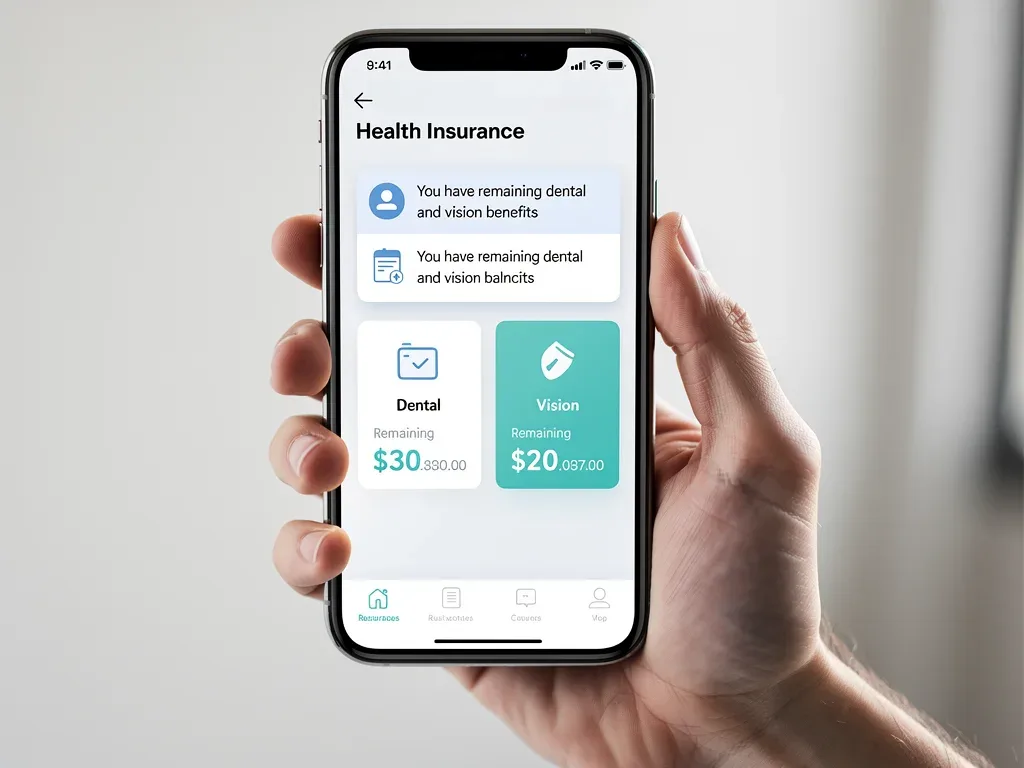
Plan Early Instead of Waiting Until December
Dental offices and optometry practices can become busier when many patients try to schedule remaining eligible services near the end of the year.
Waiting until the final days can leave insufficient time for examinations, treatment planning, laboratory work or multiple appointments required for dental procedures.
Checking benefits in late summer or early fall gives more time to make healthcare decisions without unnecessary year-end pressure.
Prioritize Clinical Need Over Expiration Dates
Urgent dental disease should not be postponed solely to obtain another year's insurance allowance when delaying treatment could worsen the condition.
Conversely, elective procedures should not be rushed simply because unused insurance capacity appears likely to expire.
The best timing combines clinical recommendations with an understanding of how deductibles, maximums and benefit periods interact.
Do Not Confuse Insurance Benefits With an FSA
A dental annual maximum or vision allowance is an insurance benefit and is fundamentally different from money contributed to a Flexible Spending Arrangement.
An FSA contains tax-advantaged employee or employer contributions that can be used for eligible expenses under separate federal and employer-plan rules.
Dental insurance rollover and FSA carryover therefore should never be treated as interchangeable concepts even when both involve year-end planning.
An FSA May Have Its Own Carryover Rules
Some health FSAs allow limited carryover or a grace period when the employer adopts those features, while others require remaining amounts to be forfeited.
Those rules operate independently from whether a dental insurer offers a maximum rollover feature or a vision plan refreshes its frame allowance.
If you have both insurance and an FSA, review each benefit separately before making year-end healthcare spending decisions.
A $500 Remaining Maximum Does Not Mean a Free $500 Procedure
Suppose a dental portal shows $500 remaining from a $1,500 annual maximum after the insurer has already paid $1,000 during the year.
A new $500 procedure could still involve deductible or coinsurance rules, meaning the insurer may pay only part of the negotiated cost.
The remaining maximum describes available insurer benefit capacity, not a promise that the next $500 of treatment will be fully paid.
Example of Coinsurance
If a covered procedure has an allowed fee of $500 and the plan pays 50%, the insurer might pay approximately $250 under simplified assumptions.
The member could owe the remaining portion, subject to deductible, network and other contractual rules, while only the insurer's payment reduces the maximum.
Real claims can be more complicated, so use the example only to understand why “remaining benefit” and “free care” are different concepts.
Dental Rollover Can Help With Future Major Treatment
For members whose plans genuinely provide maximum rollover, accumulated benefits may create additional insurance capacity for later restorative treatment.
This can be useful when a future crown, bridge or other covered procedure would otherwise consume much of one year's regular maximum.
However, stored rollover benefits remain subject to the plan's coverage rules and should not be treated as unrestricted medical savings.
Check Whether the Rollover Balance Has Its Own Maximum
Dental insurers offering these programs can restrict both the amount earned each year and the total amount accumulated over time.
A member who already reached the accumulation ceiling may not earn additional rollover even after using very little dental coverage this year.
Ask the insurer to confirm your current accumulated amount rather than estimating it from previous annual maximums.
Vision Benefits Should Be Planned Around Actual Eligibility
For vision coverage, the most useful question is often whether you are currently eligible for an exam, frame, lenses or contacts.
Someone may still be eligible for an annual exam while having to wait several additional months before a new frame allowance becomes available.
The eligibility date shown by the insurer provides more actionable information than a generic recommendation to “use your vision balance.”
Frequency Can Matter More Than the Dollar Allowance
A generous frame allowance offers little immediate value when the plan's frequency rules say the member is not yet eligible for another frame.
Conversely, a newly refreshed allowance can be valuable even if the member used another vision service earlier in the year.
Review both dollar amounts and service frequencies before assuming what remains available.
How to Review Your Benefits Before Year-End
Start by logging into your dental and vision insurance portals and locating current eligibility, claims, maximums and allowances.
Compare that information with treatment already recommended by your dentist or eye-care professional rather than searching for services solely to spend benefits.
If the terminology is unclear, call the member-services number and ask the representative to explain exactly what expires and what carries forward.
Questions Worth Asking Member Services
Ask when the benefit period ends, whether unused dental maximum rolls over and what conditions must be met to earn any carryover.
For vision coverage, ask when your exam, frame, lens and contact benefits refresh and whether using one category affects another.
Finally, confirm filing deadlines and expected out-of-pocket costs for any treatment you are considering before the benefit period closes.
Dental and Vision Benefit Rollover at a Glance
A dental and vision benefit rollover should always be evaluated plan by plan because insurers and employers can design benefits differently.
Dental coverage may use annual maximums and optional rollover programs, whereas vision coverage typically emphasizes allowances, copays and service frequencies.
The safest strategy is to confirm eligibility first, prioritize medically useful care and avoid spending solely because a benefit appears likely to expire.
What to Verify Before Spending
Confirm whether your plan truly offers rollover, how much can carry forward and whether conditions must be met before the rollover is credited.
Check your provider network, remaining deductible and expected coinsurance so you understand how much insurance will actually contribute toward care.
For vision services, verify allowance amounts and eligibility dates separately for examinations, frames, lenses and contact lenses.
Benefit Feature | What to Check |
|---|---|
Dental Annual Maximum | How much the plan can still pay during the current benefit period. |
Dental Rollover | Whether your specific plan offers it, plus earning and accumulation limits. |
Vision Allowance | Dollar amount available for qualifying frames, lenses or contacts. |
Vision Frequency | When each exam or eyewear category becomes available again. |
Plan-Year Deadline | The actual date your coverage period resets, which may not be December 31. |
Frequently Asked Questions About Dental and Vision Rollover
Do all dental plans allow unused benefits to roll over?
No. Many dental annual maximums reset each benefit period, while certain plans offer specific maximum-rollover programs subject to their own rules.
Is $500 a standard dental rollover amount?
No. Rollover amounts vary by plan, and some plans offer no rollover at all. Always confirm the amount in your own benefit documents.
Does unused vision allowance automatically roll over?
Not generally. Vision plans often use service frequencies and allowances that refresh according to the specific plan rather than accumulating unused balances.
What does a dental annual maximum mean?
It is generally the maximum amount the dental insurer will pay toward covered services during a benefit period, subject to plan rules.
Is my remaining dental maximum the same as cash?
No. It represents potential insurance coverage for eligible claims and normally cannot be withdrawn or spent on unrelated purchases.
Should I get dental work just because benefits are expiring?
No. Treatment should be clinically appropriate. Insurance timing can influence scheduling but should not create a need for unnecessary procedures.
Can preventive dental care preserve my annual maximum?
Sometimes. Certain plans exclude preventive services from the annual maximum, but others may count them, so check your specific coverage.
Can I use a vision allowance for both glasses and contacts?
It depends on the plan. Some products allow both within the same benefit year while others require choosing one category.
Does every plan reset on January 1?
No. Some benefits follow calendar years, others use employer plan years, and some vision frequencies are measured from the previous service date.
What should I do with a remaining $500 dental maximum?
Review any clinically recommended treatment, request an estimate and confirm whether the benefit expires or qualifies for rollover before scheduling care.
Conclusion
A dental and vision benefit rollover can be valuable when your specific coverage provides it, but there is no universal $500 carryover rule.
Dental annual maximums, rollover programs, vision allowances and service frequencies all operate differently and should be reviewed separately before year-end.
Use insurance for appropriate care you genuinely need, confirm deadlines and eligibility, and never assume an unused benefit balance automatically belongs to you next year.