The 2026 Guide to Community College Transfers: Maximizing Your Credits
Advertisements
Maximizing community college credits for transfer involves meticulous planning, understanding articulation agreements, and strategic course selection to ensure a seamless transition to a four-year university.
Navigating the path from community college to a four-year university can feel like a complex puzzle, but with the right strategies, it becomes a clear pathway to success. This comprehensive 2026 Guide to Community College Transfers: Maximizing Your Credits and Opportunities is designed to equip you with the knowledge and tools needed to make your transition as smooth and efficient as possible, ensuring every credit counts towards your academic and career aspirations.
Understanding the Transfer Landscape in 2026
The landscape of higher education is constantly evolving, and 2026 brings new nuances to community college transfers. Understanding these shifts is crucial for prospective students. This section will delve into the current trends and foundational elements that shape the transfer process, ensuring you are well-informed from the outset.
Transferring from a two-year institution to a four-year university is a well-trodden path for millions of students across the United States. It offers a cost-effective entry point into higher education and provides flexibility for those still defining their academic goals. However, the success of this transition heavily relies on understanding the specific requirements and opportunities available in the current educational climate.
The Evolution of Transfer Agreements
Articulation agreements, once simple documents, have become more sophisticated, reflecting a greater emphasis on student success and credit applicability. These agreements are formal partnerships between community colleges and four-year institutions that guarantee the transferability of specific courses or entire associate degrees. In 2026, many states and university systems have refined these agreements to create clearer pathways, reducing the guesswork for students.
- Statewide Transfer Initiatives: Many states now have comprehensive systems, such as the California State University (CSU) and University of California (UC) transfer pathways, or the Florida 2+2 articulation agreement, which standardize general education and major-specific course transfers.
- Program-Specific Agreements: Beyond general agreements, many institutions offer program-specific articulation agreements, ensuring that an associate degree in a particular field, like nursing or engineering, directly aligns with the first two years of a bachelor’s program.
- Reverse Transfer Options: An increasingly popular option, reverse transfer allows students who transfer before completing their associate degree to retroactively receive their associate degree once they accumulate enough credits at the four-year institution. This provides a valuable credential even if they don’t complete the bachelor’s degree.
The Role of Technology in Transfers
Technology plays an ever-growing role in simplifying the transfer process. Online transfer planning tools, degree audit systems, and virtual advising platforms are becoming standard features. These digital resources help students track their progress, identify suitable transfer courses, and connect with advisors more efficiently. Universities are also leveraging AI-powered tools to assess transfer equivalencies, making the initial credit evaluation process faster and more transparent.
Staying informed about these technological advancements can significantly streamline your transfer journey. Regularly checking your community college’s transfer center website and the prospective university’s transfer admissions page will provide access to the latest tools and resources available in 2026.
In conclusion, the 2026 transfer landscape is characterized by more robust articulation agreements and advanced technological support. Students who proactively engage with these resources and understand the evolving nature of transfer pathways will be best positioned for a successful transition.
Strategic Course Selection: Making Every Credit Count
One of the most critical aspects of a successful community college transfer is strategic course selection. It’s not just about accumulating credits; it’s about accumulating the *right* credits that will seamlessly transfer and apply towards your intended major at a four-year institution. This requires foresight, research, and careful planning from day one.
Many students make the mistake of taking courses that fulfill general education requirements at their community college but do not align with the general education or major prerequisites of their target university. This can lead to lost credits, extended study time, and increased costs. To avoid these pitfalls, a proactive approach to course planning is essential.
Identifying General Education and Major Prerequisites
Before enrolling in your first community college course, research the general education requirements of your target four-year university. These are often categorized into areas like humanities, social sciences, natural sciences, and mathematics. Additionally, pay close attention to the specific prerequisites for your intended major. For instance, an engineering major will likely require a specific sequence of calculus and physics courses, while a psychology major might need introductory statistics and research methods.
- Utilize University Catalogs: The official university catalog is your most reliable source for degree requirements. Look for the catalog year that corresponds to your intended transfer year or the year you plan to enroll.
- Consult Transfer Guides: Many universities publish specific transfer guides for community college students, detailing which courses from local community colleges will fulfill their requirements.
- Degree Audit Tools: Some universities offer online degree audit tools that allow you to input your community college courses and see how they would apply to their degree programs.
The Importance of Articulation Agreements
As mentioned earlier, articulation agreements are your best friend in ensuring credit transferability. These agreements often provide clear course equivalency charts, detailing which community college courses will be accepted for specific university courses. If an articulation agreement exists for your major and target university, follow it diligently. It’s a guaranteed pathway to credit acceptance.
If an agreement doesn’t exist, or if you’re considering a university without one, it becomes even more crucial to work closely with both your community college advisor and an admissions counselor at your target university. They can provide guidance on course selection and help you understand the university’s policies on evaluating credits from unarticulated institutions.
Considering Electives and GPA Impact
While focusing on required courses, don’t overlook electives. Choose electives that either fulfill general education requirements at your target university or provide foundational knowledge relevant to your major. Additionally, maintain a strong GPA. Most universities have minimum GPA requirements for transfer students, and a competitive GPA can significantly enhance your chances of admission, especially for selective programs.

In summary, strategic course selection is paramount. By thoroughly researching university requirements, leveraging articulation agreements, and maintaining academic excellence, you can ensure that every credit earned at community college propels you closer to your bachelor’s degree.
Navigating the Application Process: Tips for 2026
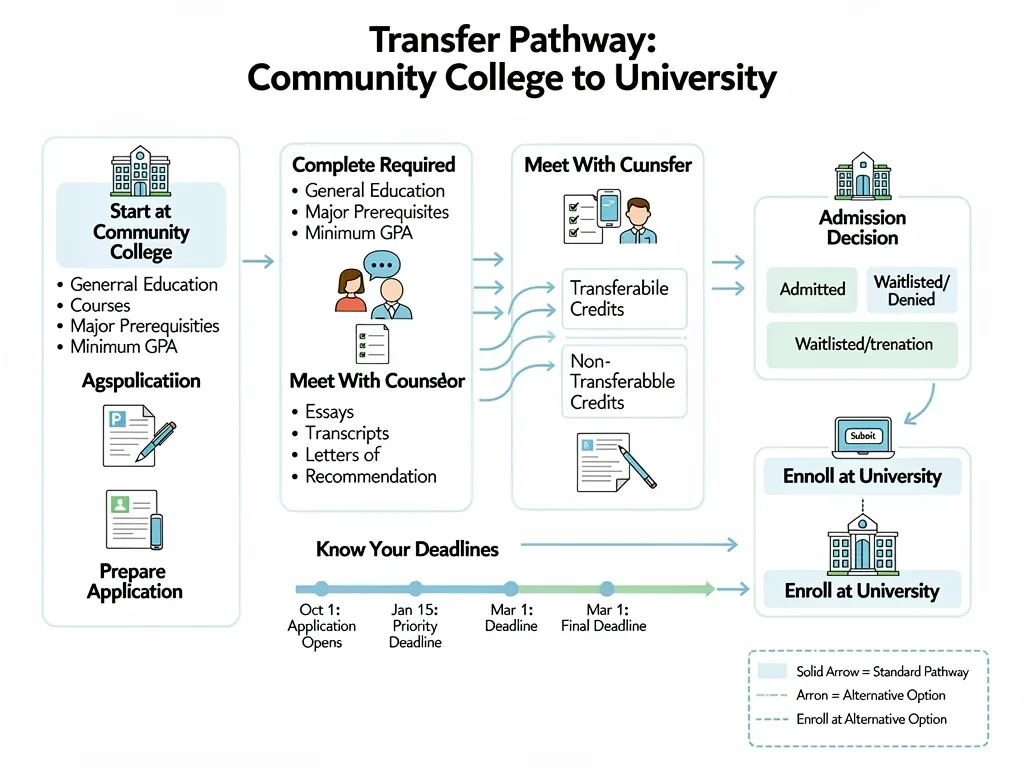
The transfer application process can be as intricate as freshman admissions, but with its own unique set of considerations. For 2026, transfer applicants should be acutely aware of deadlines, required documentation, and how to effectively present their academic journey. A well-prepared application can significantly boost your chances of acceptance.
Unlike first-year applicants who are primarily evaluated on high school transcripts and standardized test scores, transfer applicants are assessed based on their community college academic performance, the applicability of their coursework, and sometimes, their essays and extracurricular involvement. Understanding these distinctions is key to crafting a compelling application.
Key Application Components and Deadlines
Most transfer applications will require official transcripts from all previously attended institutions, including high school and any other colleges. You’ll also typically need to submit essays or personal statements, letters of recommendation (though these are less common for transfers than for first-year applicants), and a list of extracurricular activities or work experience. Always double-check the specific requirements for each university you apply to, as they can vary significantly.
- Early Application: Many universities have early action or priority deadlines for transfer students. Applying early can sometimes offer an advantage, particularly for programs with limited space.
- Financial Aid Deadlines: Be mindful of financial aid deadlines, which are often separate from admission deadlines. Completing the FAFSA (Free Application for Federal Student Aid) and any institutional aid applications on time is crucial for maximizing aid opportunities.
- Portfolio or Audition Requirements: For certain majors like art, music, or architecture, a portfolio or audition may be required. Start preparing these well in advance, as they often take considerable time and effort.
Crafting a Compelling Personal Statement
Your personal statement or essay is an opportunity to tell your story and explain why you want to transfer to a particular institution and major. Unlike freshman essays, transfer essays often focus on your experiences at community college, lessons learned, and how those experiences have prepared you for university-level study. Highlight your academic growth, resilience, and specific reasons for choosing your target university.
Avoid simply restating your resume. Instead, use vivid anecdotes and reflective insights to demonstrate your passion for your chosen field and your readiness for the challenges of a four-year university. Tailor each essay to the specific institution, showcasing your knowledge of their programs and resources.
Letters of Recommendation and Interviews
While not universally required, some competitive programs may request letters of recommendation. If so, choose professors who know you well and can speak to your academic abilities and potential. Provide them with ample notice and any relevant materials, such as your resume or personal statement, to help them write a strong letter.
Interviews are less common for transfer applicants but can occur, especially for specialized programs or highly selective institutions. If offered an interview, treat it as a professional opportunity to articulate your goals and demonstrate your fit for the university.
By meticulously preparing your application, adhering to deadlines, and thoughtfully presenting your academic narrative, you can navigate the 2026 transfer application process successfully and secure your spot at your dream university.
Maximizing Financial Aid and Scholarship Opportunities
The cost of a four-year degree can be substantial, making financial aid and scholarships critical for many transfer students. Understanding the unique financial aid landscape for transfers and actively seeking out opportunities can significantly reduce the financial burden of higher education. This section explores strategies for maximizing your financial support in 2026.
Many students mistakenly believe that financial aid is less available for transfer students compared to first-year applicants. While some scholarships are specifically for incoming freshmen, a plethora of aid options exists for transfers, including federal aid, state grants, institutional scholarships, and private awards. The key is knowing where to look and how to apply effectively.
Federal and State Financial Aid
The Free Application for Federal Student Aid (FAFSA) is the gateway to federal grants, loans, and work-study programs. As a transfer student, you’ll need to re-file the FAFSA each year you plan to attend university. Be sure to meet the priority filing deadlines, as some aid is awarded on a first-come, first-served basis. State grants also play a significant role, with many states offering programs specifically for residents attending in-state public universities.
- FAFSA Submission: Complete the FAFSA as early as possible, typically beginning October 1st for the following academic year.
- State-Specific Programs: Research state education agency websites for grants and scholarships available to transfer students within your state.
- University Financial Aid Offices: Connect with the financial aid office at your target university to understand their specific policies and available institutional aid.
Institutional Scholarships for Transfers
Many four-year universities offer scholarships specifically for transfer students. These can be merit-based, need-based, or program-specific. Some institutions have dedicated transfer scholarship applications, while others automatically consider transfer applicants for scholarships based on their admission application. High academic achievement at community college, particularly a strong GPA, is often a key factor for merit scholarships.
Don’t assume you won’t qualify. Always inquire about transfer-specific scholarships and any additional application steps. Some universities also offer scholarships for students transferring from specific community colleges with which they have strong articulation agreements.
External Scholarships and Private Aid
Beyond federal, state, and institutional aid, numerous external organizations offer scholarships. These can range from local community groups to national foundations. Scholarship search engines are valuable tools for finding these opportunities. Look for scholarships based on your major, ethnicity, community involvement, or unique circumstances.
When applying for private scholarships, pay close attention to the essay prompts and submission requirements. Tailoring your application to each scholarship’s criteria can increase your chances of success. Additionally, consider scholarships offered by professional organizations related to your intended major, as these often have less competition.
In conclusion, maximizing financial aid and scholarship opportunities requires diligence and proactive effort. By thoroughly exploring federal, state, institutional, and private aid options, transfer students can significantly reduce the financial burden of their bachelor’s degree and focus on their academic pursuits.
Leveraging Support Systems and Resources
Successfully navigating the transfer process is rarely a solitary journey. Both community colleges and four-year universities offer a wealth of support systems and resources designed to assist transfer students. Leveraging these resources can provide invaluable guidance, academic support, and a smoother transition. This section highlights key support avenues available in 2026.
From academic advising to career services, and from peer mentoring to specialized transfer centers, these resources are put in place to ensure students don’t just transfer, but thrive. Many students underestimate the value of these services or are simply unaware of their existence. Proactively seeking them out can make a significant difference in your academic success and overall experience.
Community College Transfer Centers and Advisors
Your community college’s transfer center is often the first and most crucial point of contact. These centers are staffed by advisors who specialize in transfer pathways. They can help you identify target universities, understand articulation agreements, plan your course schedule, and even assist with the application process. Many centers also host university representatives and transfer fairs, providing direct access to admissions counselors.
- Regular Advising Appointments: Schedule regular meetings with your transfer advisor to review your academic plan and ensure you’re on track.
- Transfer Workshops: Attend workshops on topics like personal statement writing, financial aid for transfers, or understanding specific university requirements.
- University Visits: Participate in campus visits or virtual tours organized by the transfer center to get a feel for potential target institutions.
University Transfer Student Services
Once you’ve been accepted, many four-year universities offer dedicated services for incoming transfer students. These can include orientation programs specifically designed for transfers, peer mentoring programs, and transfer student organizations. These services help new transfers acclimate to the university environment, connect with peers, and access academic and social support.
Don’t hesitate to utilize these services. The university environment can be different from community college, and these programs are designed to help you bridge that gap. Connecting with other transfer students can also provide a valuable support network, as they often share similar experiences and challenges.
Academic Support and Career Services
Both community colleges and universities offer extensive academic support, including tutoring centers, writing labs, and study skills workshops. As a transfer student, you might encounter new academic challenges, and these resources can be instrumental in maintaining your GPA and academic performance. Additionally, career services offices can help you explore majors, prepare for internships, and develop job search strategies, even before you officially transfer.
In conclusion, actively engaging with the support systems and resources available at both your community college and target university is vital. These services provide the guidance and assistance necessary to navigate the transfer process successfully and thrive in your new academic environment.
The Importance of Early Planning and Proactive Engagement
The overarching theme for a successful community college transfer in 2026 is early planning and proactive engagement. Waiting until the last minute to research transfer requirements or connect with advisors can lead to missed opportunities, wasted credits, and unnecessary stress. Beginning the planning process early allows for flexibility, informed decision-making, and a much smoother transition.
Think of the transfer process not as a series of hurdles, but as a carefully constructed bridge. Each step, from initial research to final application, is a component of that bridge. By building each component thoughtfully and in advance, you ensure a sturdy and reliable path to your four-year degree.
Starting Your Research Early
As soon as you decide to attend community college with the intention of transferring, begin researching potential four-year universities and their transfer requirements. Don’t wait until your second year. Look at their admissions criteria, major prerequisites, and, most importantly, their articulation agreements with your community college. This early research will inform your course selection from your very first semester.
- Create a Transfer Plan: Develop a tentative academic plan that outlines which courses you’ll take each semester at community college, ensuring they align with your target university’s requirements.
- Identify Backup Options: Have a few backup universities in mind. While you might have a dream school, having alternatives ensures you have options if your primary choice doesn’t work out.
- Attend Information Sessions: Many universities host virtual and in-person information sessions specifically for prospective transfer students. These are excellent opportunities to gather information and ask questions.
Building Relationships with Advisors and Faculty
Establishing a strong relationship with your community college transfer advisor is paramount. They are experts in the transfer process and can provide personalized guidance. Additionally, connecting with faculty in your intended major can open doors to research opportunities, letters of recommendation, and valuable insights into your field. These relationships can be instrumental in both your academic and professional development.
Don’t be afraid to ask questions, even if they seem minor. Proactive communication with your advisors and professors demonstrates your commitment and helps ensure you receive the support you need. They are there to help you succeed.
Staying Organized and Meeting Deadlines
The transfer process involves numerous deadlines for applications, financial aid, and transcript submissions. Create a detailed timeline or calendar to keep track of all important dates. Missing a deadline, especially for financial aid or competitive programs, can have significant consequences. Organization is key to managing the various components of your transfer application.
Keep copies of all submitted documents and communications. This meticulous record-keeping can be invaluable if any questions or discrepancies arise during the application review process. A well-organized approach reduces stress and increases the likelihood of a smooth transfer.
In conclusion, early planning and proactive engagement are the cornerstones of a successful community college transfer. By starting your research early, building strong relationships, and maintaining meticulous organization, you can confidently navigate the path to your four-year degree and maximize every opportunity along the way.
Key Trends and Future Outlook for Transfers in 2026
As we look ahead to 2026 and beyond, several key trends are shaping the landscape of community college transfers. These developments offer both new opportunities and potential challenges for students. Understanding these trends can help you better prepare for your academic journey and leverage emerging pathways.
The higher education system is dynamic, constantly adapting to economic shifts, technological advancements, and evolving student needs. For transfer students, this means a continuous evolution in how credits are accepted, how support is provided, and what opportunities are available for seamless progression to a bachelor’s degree.
Increased Emphasis on Career-Aligned Pathways
There’s a growing trend towards creating more direct and career-aligned transfer pathways. Universities are increasingly partnering with community colleges to develop programs that not only ensure credit transfer but also equip students with specific skills for in-demand industries. This focus on workforce development means that associate degrees are becoming more explicitly linked to bachelor’s programs that lead to specific career outcomes.
- Applied Bachelor’s Degrees: Some community colleges are beginning to offer applied bachelor’s degrees, particularly in technical fields, providing another option for students who wish to remain in the community college system for their entire four-year degree.
- Employer Partnerships: Universities and community colleges are forging stronger ties with employers to ensure that transfer curricula are relevant to industry needs, making graduates more competitive in the job market.
- Stackable Credentials: The concept of stackable credentials, where certificates and associate degrees build seamlessly into bachelor’s degrees, is gaining traction, offering more flexible educational pathways.
Digitalization and Accessibility of Resources
The reliance on digital tools for transfer planning and support will only continue to grow. Online degree planners, virtual advising sessions, and AI-powered transfer credit evaluators will become more sophisticated and widely adopted. This increased digitalization aims to make the transfer process more transparent and accessible, especially for non-traditional students or those in remote areas.
Expect more personalized online dashboards where students can track their transfer progress, connect with advisors, and access resources tailored to their specific transfer goals. This shift towards digital-first services will empower students with more control and information throughout their journey.
Focus on Holistic Review for Transfers
While GPA and course equivalencies remain critical, some universities are adopting a more holistic review process for transfer applicants. This means considering factors beyond academic metrics, such as leadership experience, community involvement, work history, and the personal statement. This approach aims to recognize the diverse experiences and maturity that many transfer students bring to the university environment.
For students, this trend emphasizes the importance of a well-rounded profile and the ability to articulate how their experiences have prepared them for university success. It encourages students to engage in activities outside of academics that demonstrate their potential contributions to the university community.
In conclusion, the future of community college transfers in 2026 is characterized by a greater alignment with career outcomes, enhanced digital support, and a more holistic approach to admissions. By staying informed about these trends, students can strategically position themselves for a successful and rewarding transfer experience.
Common Pitfalls to Avoid During Transfer
While the path to transferring from community college to a four-year university is well-defined for many, several common pitfalls can derail even the most prepared students. Being aware of these potential obstacles is the first step in avoiding them, ensuring a smoother and more efficient transition. This section outlines typical mistakes and how to sidestep them.
Many of these pitfalls stem from a lack of information, insufficient planning, or underestimating the complexities involved. By proactively addressing these areas, transfer students can save time, money, and unnecessary stress, staying firmly on track towards their bachelor’s degree.
Ignoring Articulation Agreements or Transfer Guides
One of the most frequent mistakes is not fully utilizing or understanding articulation agreements and official transfer guides. These documents are designed to guarantee credit transferability. Students who take courses not explicitly listed in these agreements risk having those credits not accepted, leading to needing to retake courses or take additional ones, prolonging their degree completion.
- Always Cross-Reference: Before registering for any course, cross-reference it with your target university’s transfer guide or articulation agreement.
- Seek Confirmation: If there’s any doubt about a course’s transferability, get written confirmation from the target university’s admissions or registrar’s office.
- Don’t Assume: Never assume a course will transfer just because it’s a general education requirement at your community college. University requirements can differ.
Underestimating GPA Requirements
While community colleges often have lower admission standards than four-year universities, transfer admission can be highly competitive, especially for popular majors or selective institutions. Many universities have minimum GPA requirements for transfer students, and some programs require an even higher GPA. Underestimating this can lead to disappointment.
Maintain the highest possible GPA throughout your community college career. A strong academic record not only improves your chances of admission but also makes you a more attractive candidate for transfer scholarships. If your GPA is borderline, focus on demonstrating an upward trend in your academic performance.
Late Application or Missing Deadlines
Transfer application deadlines can vary significantly from first-year admissions and often differ between universities. Missing an application deadline, especially for competitive programs or financial aid, can mean delaying your transfer by a semester or even a year. This oversight can be costly both in terms of time and money.
Create a comprehensive timeline for each university you plan to apply to, including application deadlines, financial aid deadlines, and transcript submission dates. Set reminders and submit all materials well in advance of the due dates to avoid any last-minute issues.
In conclusion, avoiding common pitfalls requires diligent research, careful planning, and proactive engagement with available resources. By being aware of these potential obstacles and taking steps to circumvent them, transfer students can ensure a smooth and successful transition to their four-year university.
Preparing for University Life as a Transfer Student
The transition to a four-year university as a transfer student involves more than just academic readiness; it also requires preparing for a new social and cultural environment. While you’ve already experienced college life at a community college, a university often presents a different scale and set of expectations. Proactive preparation can help you integrate smoothly and thrive in your new setting.
Transfer students often bring a unique maturity and focus to their new institutions, but they can also face challenges like finding a new social circle or adapting to a larger campus. Addressing these aspects before you arrive can significantly enhance your overall university experience.
Academically Adapting to University Rigor
University courses can often be more demanding in terms of workload, research expectations, and independent study. While your community college education has prepared you, be ready to adjust to a potentially faster pace and more in-depth academic inquiry. Utilize academic support services like writing centers and tutoring from day one if you feel the need.
- Time Management: Develop strong time management skills to balance coursework, social life, and any part-time work.
- Research Skills: Familiarize yourself with the university library’s resources and learn how to conduct more advanced academic research.
- Professor Engagement: Attend office hours and build relationships with your university professors. They can be invaluable mentors and resources.
Building a New Social Network
One common challenge for transfer students is finding a new social circle. Most first-year students form bonds during orientation, and transfer students might feel like they’re joining a group already in progress. Actively seek out opportunities to meet new people and get involved on campus. Join clubs, participate in intramural sports, or attend campus events.
Many universities have transfer student organizations specifically designed to help you connect with peers who share similar experiences. These groups can be a great way to find friends, share advice, and build a support network. Don’t be afraid to put yourself out there and initiate conversations.
Exploring Campus Resources and Opportunities
Four-year universities typically offer a vast array of resources, from career services and mental health support to recreational facilities and cultural centers. Take the time to explore these offerings and understand how they can benefit you. Attending orientation programs, even if they seem basic, can introduce you to key departments and individuals who can support your success.
Consider taking advantage of internships, study abroad programs, or research opportunities that might be available at your university. These experiences can enrich your academic journey and significantly boost your resume for post-graduation plans. Being proactive in exploring and utilizing these resources will make your university experience much more fulfilling.
In conclusion, preparing for university life as a transfer student involves both academic and social adjustments. By being proactive in adapting to academic rigor, building new social connections, and leveraging campus resources, you can ensure a successful and enriching experience at your new institution.
| Key Aspect | Brief Description |
|---|---|
| Credit Maximization | Strategically select courses aligned with target university’s articulation agreements and major prerequisites. |
| Application Process | Adhere to deadlines, craft compelling essays, and submit all required documentation meticulously. |
| Financial Aid | Explore federal, state, institutional, and private scholarships specific to transfer students. |
| Support Systems | Utilize transfer centers, academic advisors, and university-specific transfer student services. |
Frequently Asked Questions About Community College Transfers
How do I ensure my community college credits will transfer to a four-year university?▼To ensure credit transferability, meticulously review articulation agreements between your community college and target university. Consult with academic advisors at both institutions early and often. Always cross-reference your course selections with the university’s official transfer guides and degree catalogs to confirm equivalencies before enrolling in classes.
What is an articulation agreement, and why is it important?▼An articulation agreement is a formal, written agreement between two educational institutions that guarantees the transfer of credits for specific courses or entire degree programs. It’s crucial because it provides a clear, pre-approved pathway, ensuring your community college coursework will be accepted and applied towards your bachelor’s degree, saving you time and money.
Are there specific scholarships for community college transfer students?▼Yes, many four-year universities offer scholarships specifically for transfer students, often based on academic merit or financial need. Additionally, various external organizations and foundations provide scholarships for transfers. You should also complete the FAFSA for federal and state aid, as well as inquire with your community college’s financial aid office for local opportunities.
When should I start planning my community college transfer?▼You should start planning your community college transfer as early as possible, ideally during your very first semester. This allows ample time to research target universities, understand their specific transfer requirements, meet with advisors, and select courses strategically. Early planning helps avoid common pitfalls and ensures a smoother, more efficient transition.
How can I make the social transition to a new university easier as a transfer student?▼To ease the social transition, actively seek out opportunities to get involved on campus. Join student organizations, participate in intramural sports, attend campus events, and connect with transfer student services. Many universities have dedicated transfer student groups that provide a ready-made community and support network, helping you meet new friends and acclimate.
Conclusion
Successfully navigating the journey from community college to a four-year university in 2026 is an achievable goal for many students, provided they approach the process with diligence and foresight. By understanding the evolving transfer landscape, strategically selecting courses, meticulously managing the application process, and actively leveraging available financial aid and support systems, students can maximize their credits and unlock a wealth of academic and career opportunities. Early planning, proactive engagement with advisors, and a commitment to academic excellence are the cornerstones of a smooth and rewarding transfer experience, paving the way for a successful future.